Newsreader Script Voice Piece
Teenagers texting whilst driving has caused numerous accidents over the past years leading to investigations into whether younger drivers should be allowed on the roads.
Our reporters Rebecca Lavin and Christopher Donaldson are Live from South Downs College reviewing the highly discussed issue of teenagers texting whilst behind the wheel.
Cut: Donaldson1
Dur: 40 Secs
Out: Lavin1
Reporters Voice Piece
Chris: Hello, welcome to South Downs News.
Rebecca: We are here today reporting live from South Downs College, discussing the topic of teenagers texting whilst driving.
Chris: 33% of deaths among 13 to 19-year-olds in 2010 occurred in motor vehicle crashes.
Rebecca: This is a terrifying statistic which is why change must begin as soon as possible.
Chris: We are now here joined with Charlotte, a 17 year old student who's recently passed her driving test.
Rebecca: Whats your thoughts on teenagers who text whilst driving?
Charlotte: I think texting whilst driving isn't good and I would never personally do it. I understand sometimes if its an emergency and you have to reply straightaway than its acceptable to text and drive, but if people just do it for the sake of it then I don't agree.
Chris: If you were in a vehicle with somebody who was texting would you intervene?
Charlotte: Yeah I would try to stop them as they are putting my life and others in danger. If it was say in a traffic jam where we wouldn't be moving for a while then I would maybe not intervene but if I thought I was in danger I'd definitely speak up.
Rebecca: Only 44% of teens said they would definitely speak up if someone were driving in a way that scared them.
Chris: Talking on a cell phone can double the likelihood of an accident as well as slow a young driver’s reaction time down to that of a 70-year-old.
Chris: Teen drivers with involved parents are twice as likely to wear seat belts.
Rebecca: Only 44% of teens said they would definitely speak up if someone were driving in a way that scared them.
Chris: Statistics show that 17 and 18-year-old driver death rates increase with each additional passenger.
Rebecca: I hope you have found this to be helpful and informative.
Chris: So next time you debate texting whilst driving, just remember your putting your life and others in danger.
Chris: And this has been Chris and Lucy reporting for South Downs News.
Rebecca: Thank you for watching, back to the studio.
Vox Pop
(News readers asks the question 'whats your thoughts on teenagers texting whilst driving?')
Vox Pop Response:
I think texting and driving is bad and anybody who considers doing it should be ashamed. I would never personally do it as I think it puts peoples lives in danger. Being safe on the roads is way more important than answering a phone call or text.
(News readers asks the question 'If you were in a vehicle with somebody who was texting would you intervene?)
Vox Pop Response:
I personally would definitely intervene as its my life at risk just as much as the drivers and other people on the road. I have never been in a car where someone has texted and drove but if I did I would feel like its my right to say something so I would.
(News reader asks the question 'Would you ever text whilst driving?')
Vox Pop Response:
No I wouldn't think about doing that. Its stupid and unneeded, answering a call or text should not be peoples main priority whilst driving. I've just recently passed my test and I'm already scared of other drivers on the road purely for the fact of things like texting whilst driving, I just think people shouldn't do it.
Final Radio Vox Pop Piece
This is the final finished version of our radio vox pop piece, we edited it through Adobe Audition, the changes we made were are as follows; cropping and cutting certain sections, replacing parts with different recordings and manipulating certain responses to fit within the style of a vox pop. After we changed the recording to an MP3 we uploaded it via Chirbit.
Check this out on Chirbit
Evaluation
The story I was assigned to do was about teenager’s texting whilst driving, this story has a lot of news value as it effects a large majority of society. A lot of people drive or are aware of people that do, so the thought of a generation putting people’s lives at risk would grab attention and be engaging. I was pleased with the story I was given as I felt I could create a news story and radio vox pop piece to a great standard with such a in depth story. The target audience for ‘teenager’s texting whilst driving’ specifically relates to teenagers it also relates to near enough everyone from people who drive, passengers in vehicles to people who are learning to drive. This is also a story which people would find interesting and want to hear more about as it does relate to such a wide variety of audiences. This story being about teenagers would firstly draw attention to teens but also parents and grandparents, older people who do reservations about young drivers as they are constantly stereotyped as being 'bad' drivers. This story appeals the audience for the simple fact it effects a wide variety of people and is a serious matter as texting whilst driving is illegal and puts people’s lives in danger.
I have demonstrated a variety of professional practice within my film and radio piece. To start with my filming assignment reflects professionalism as I used a mixture of different and expert angles like cut away shots, long distance shots and close ups. I also made sure the actors and actresses I decided to use for the filming were the best I could find, I wanted the news film to be as professional as possible which is why I choose actors and actress who were up to that standard and what I wanted to represent our news programme. Another example of how my film treatment reflects professional practice is the script. Throughout this assignment I researched a variety of different news programmes and looked into how the way news reporters speak, what they say etc. and due to this made sure the script reflected that. I used the conventional aspect of the news reporters introducing themselves and addressing what location they are at so it related to a traditional style news report. Some examples of how I established professional practice in my radio assignment are as follows; when collecting vox pops, I looked into different ones through research (Radio 1 News, BBC News ect.) All of the vox pops I listened to all stuck to a similar style of clear voices, lack of background sound and short answers, due to this I decided to make sure my vox pops were to a similar theme. When doing vox pops I was sure to do them in areas which weren’t surrounded by a lot of background sounds and asked questions which were recognizable and allowed the person to give a detailed answer. The voice piece in my radio assignment also demonstrated professional practice because the voice was clear and understandable. The way the voice piece and vox pops were edited also showed professionalism as personally I feel it sounds similar to ones you would hear on the radio.
A lot of the places where I sourced my information for both my radio and television assignment were from the Internet. After I discovered the story I was assigned to I straight away started researching facts and figures, information and incidents which may have appeared in the public eye which involves not just teenagers but people in general texting whilst driving. I found a lot of facts and figures such as 33% of deaths among 13 to 19-year-olds in 2010 occurred in motor vehicle crashes and 56% of teens said they talk on the phone while driving on a website called ‘No Texting Whilst Driving’.
A feel I have a lot of strengths as well as some weaknesses in both of my television and radio assignments. The strengths I have in my television assignment are as follows; as an overview I’m pleased with how my news film has ended up as it’s demonstrated the style of a professional news programmes. The whole film I feel was finished to a high standard as I used different, good quality shots, a couple of good actors/actresses and a script which displays effectiveness. The weaknesses in this news programme is maybe the lack of interviews within. I only used on particular person who got asked questions by the news reporters. So if I was to complete this assignment again I would make sure I had arranged an interview with another person who maybe would be more significant to the story like a policeman or someone who has been involved in a car accident but specifically when someone was on their phone. The strengths in my radio assignment are I feel that my audio piece was to a professional and good quality standard. I enjoyed researching different audio on the radio and due to this I feel this is why the vox pop and voice piece I created relates to it and does sound strikingly similar. My vox pops in particular I’m impressed with as I feel they are clear, understandable and relate to the style of radio vox pops. One weakness I felt I had with this radio assignment is although I was happy with my vox pops if I was to do the task again I would ask a more variety of questions to get a different response.
Monday, 18 May 2015

Thursday, 26 February 2015
Radio News Practice
Task 1:
Look at the following story from Hampshire Police
• What are the 5 W’s ?
• Is any part of this story opinion?
• Write this story into a piece of copy as close to 90 words long as possible, aiming to use the 3 C’s and 5 W’s
1. Who
2. Where
3. When
4. Why
5. What
Police are investigating a report of an assault on a woman with learning difficulties in Southsea on Christmas Day.
The 25-year-old, who has a rare genetic condition called Williams syndrome, was walking along St. Andrews Road near Hudson Road at around 5.20pm on Sunday, December 25, 2011 when she was approached by a group of boys.
It’s alleged the boys verbally abused and threatened her before assaulting this woman and her pet cat, which was following her.
The woman received slight bruising to her face, and was left frightened and distressed by these events. She went back to her flat and locked herself in shortly after the assault, which was later reported to the police by her family.
The group of boys were described as being aged between 12 and 15. They were riding a number of micro-scooters and one bicycle. One of the boys was wearing blue jeans and a blue top with the hood up.
A Hampshire Constabulary spokesman said: "These were cruel and despicable actions towards a vulnerable woman who is usually trusting of people as she tries to lead an independent life.
"On Christmas Day evening, this woman wanted to prove her independence by walking from her flat to her mother’s address nearby for the first time in the dark. It’s believed that the group of boys targeted this woman because of her appearance and the way she walks, which is as a result of challenges with her co-ordination.
"We are appealing for witnesses to this assault in St. Andrews Road on Christmas Day or anyone with information about the identities of the youth suspects."
People with information are asked to contact Southsea police station by phoning 101. Mini-com users can phone 01962 875000. Information can be given anonymously by phoning the independent Crimestoppers charity on 0800 555 111.
Look at the following story from Hampshire Police
• What are the 5 W’s ?
• Is any part of this story opinion?
• Write this story into a piece of copy as close to 90 words long as possible, aiming to use the 3 C’s and 5 W’s
1. Who
2. Where
3. When
4. Why
5. What
Police are investigating a report of an assault on a woman with learning difficulties in Southsea on Christmas Day.
The 25-year-old, who has a rare genetic condition called Williams syndrome, was walking along St. Andrews Road near Hudson Road at around 5.20pm on Sunday, December 25, 2011 when she was approached by a group of boys.
It’s alleged the boys verbally abused and threatened her before assaulting this woman and her pet cat, which was following her.
The woman received slight bruising to her face, and was left frightened and distressed by these events. She went back to her flat and locked herself in shortly after the assault, which was later reported to the police by her family.
The group of boys were described as being aged between 12 and 15. They were riding a number of micro-scooters and one bicycle. One of the boys was wearing blue jeans and a blue top with the hood up.
A Hampshire Constabulary spokesman said: "These were cruel and despicable actions towards a vulnerable woman who is usually trusting of people as she tries to lead an independent life.
"On Christmas Day evening, this woman wanted to prove her independence by walking from her flat to her mother’s address nearby for the first time in the dark. It’s believed that the group of boys targeted this woman because of her appearance and the way she walks, which is as a result of challenges with her co-ordination.
"We are appealing for witnesses to this assault in St. Andrews Road on Christmas Day or anyone with information about the identities of the youth suspects."
People with information are asked to contact Southsea police station by phoning 101. Mini-com users can phone 01962 875000. Information can be given anonymously by phoning the independent Crimestoppers charity on 0800 555 111.
1. Who - 25 year old with Williams syndrome.
2. Where - St. Andrews Road near Hudson Road.
3. When - 5.20pm on Sunday, 25th December 2011.
4. Why - Woman wanted to prove her independence by walking from her flat to her mother’s address nearby for the first time in the dark.
5. What -Verbally abused and threatened her before assaulting this woman and her pet cat.
Tuesday, 3 February 2015
Assignment Two - Law
Assignment two - Law
Journalism laws will always be important in today’s society but specifically due to the digital age. Since the developments of technology including the use of online articles rather than articles only being printed on newspapers and magazines and the rise of social media giving people the platform to say pretty much whatever they want to a wider audience. In the digital age where people publish a lot more online moves away from the more known areas of law like defamation, libel, contempt of court and privilege and a creates a whole new world of law in journalism.
 Defamation is a law which allows individuals, groups of individuals, firms or companies to sue when there reputation is being damaged. Someone can be defamed when material is published in various forms which isn’t truthful or portrays the accused in a bad light. People can sue so long as the material can be reasonably understood to be referring to them. Something is defamatory if it lowers the accused in in the estimation of right-thinking members of the public and/or causes them to be shunned or avoided. Defamatory also is when it disparages them in their office, trade or profession and/or exposes them to hatred ridicule or contempt. The Defamation Act 2013 which came into effect in England and Wales on the 1st of January 2013 has since made several changes. Under the new law claimants have to show that the publication has caused, or is likely to cause, ‘serious harm’ to their reputation. If the claimant is a body that trades for profit, such as a company, serious harm is defined as ‘serious financial losses. It is up to the courts to decide how they interpret “serious harm” in individual cases.
 The UK Defamation Act 1996, exists to protect the reputation and good standing of an individual. In order to pursue a successful defamation suit the claimant must: prove that they have a reputation which can be damaged and be able to show that their reputation has been damaged. The 1996 version of the act was replaced by the 2013 version which changed a number of Defamation procedures. All defamation cases under the Senior Courts Act 1981 in the Queen’s Bench Division, and the County Courts Act 1984, which were “tried with a jury”, unless the trial requires prolonged examination of documents &c, are now “tried without a jury” unless the court orders otherwise. Such cases are referred through a Defamation Recognition Commission (DRC) to a new Independent Regulatory Board (IRB), to provide arbitration services. The Courts should take into account, when awarding costs and damages, whether either party in a dispute has chosen not to use the arbitration service. A successful party is required to pay all of the proceedings costs, if such a party unreasonably refused to use the arbitration service. Judgment awards of exemplary damages, where a defendant is guilty of breach of a defendant’s rights, can take into account whether either party refused to use, or join the arbitration service. Courts should take into account whether defendant first sought advice from the IRB before publication. It was changed to give a better protection to people expressing their opinions are to come into force in England and Wales.
There are many ways in which someone can be defamed and in various forms. Some of them include through newspapers, magazines and other printed media, radio and television broadcasting, email and through the web which includes social media, blogging sites and online forums. You can be put at risk of defaming someone even if you repeat defamatory comments previously made or published by others, for example if you quote a defamatory comment on social media. However the claimant would need to have evidential proof that the defamatory material is aimed at them even if they aren’t specifically named. Some of the defences have been amended by the latest legislation, which includes the following; the person who publishes the comments must prove what is said is true. The opinions must be completely factual and genuine as well as how much the publication is public interest.
 An example of a libel case which involves defamation is the Frankie Boyle case. The sweary comic won £54,650 in damages after a High Court jury found that the Daily Mirror had libelled him by calling him a “racist comedian”. This is a strong case of defamation as the famous newspaper completely tarnished the comedians identity as being accused of racism is an extremely serious thing. Contempt of Court is a phrase which covers a wide variety of conduct which undermines or has the potential to undermine the course of justice, and the procedures which are designed to deal with them. The Law Commission’s consultation paper on contempt of court was published in November 2012 focuses on a number of areas which are as follows. Contempt by publication is based around the balance the right of a defendant to a fair trial with the right of the publisher to freedom of expression. There are also concerns that the procedures for dealing with this form of contempt may not be as fair and efficient as possible. The impact of the new media also relates to Contempt of Court which is contained in the 1981 Act, as the act pre-dates the internet and the concerns that the current law cannot adequately deal with contempt’s committed through the new media. Contempt’s committed by jurors relates to the need to ensure that the laws and procedures strike a balance between the public interest in the administration of justice, the defendant’s right to a fair trial, and the rights of the jurors concerned.
 Reporting restrictions is under section 4(2) of the Contempt of Court Act 1981. Reporting restrictions exist reports of committal proceedings, preparatory hearings (Crown Court) in serious fraud cases, divorce and matrimonial cases and certain sex cases. Courts also have power to order the postponement of the reporting of a case while there is danger of it causing prejudice, usually when people are tried separately on charges arising from the same incident or where the accused is also a defendant in other proceedings. The restrictions do not apply if the accused person applies to have them lifted, the magistrates decide not to commit, or the court decides to deal with the case summarily. If the court commits some people and tries others summarily, evidence relevant to those dealt with summarily may be reported. If one or more of the accused wants the restrictions lifted and others want them to stay, the court gives a ruling. Reports from divorce courts and magistrates' court matrimonial hearings may contain only names, addresses and occupations of the parties and witnesses, a concise statement of the charges, defence and counter-charges on which evidence has been given, submissions and decisions on points of law, the judgment and any observations of the court. Even when there is no legal prohibition, complainants in other sex cases should be identified only after reference to the news desk or senior production staff.
 Following the sentencing of Venables over child pornography charges, Mr Justice Bean reiterated the view of the courts that revealing his new identity risked endangering his life. But some media groups argued the reporting restrictions were draconian and an affront to the principle of open justice. The judge did relax reporting restrictions on naming the region, Cheshire, where Venables lived at the time he was recalled to prison in March this year, as well as the probation service that was supervising him. But Mr Justice Bean reiterated that the reporting restrictions to protect Venables' new identity, his address before he was recalled to prison, his whereabouts now, and his appearance, still stand and are permanent. Reporting restrictions have been in place ever since Venables and Robert Thompson, who were convicted for the murder of James Bulger, were released on license with new identities in 2001. At that time, Dame Elizabeth Butler-Sloss granted a high court injunction to prevent publication of their new identities on the basis that there was a real possibility of serious physical harm or death from vengeful members of the public. Revealing the identity of the James Bulger murderers was done because of how high the public interest was because considering the case was about a child being killed which effects the whole of the public as one it was a murder but two it was of a child which puts other children at risk considering it could have been a serial child killer involved. The identity’s was also revealed as Venables and Thompson was criminals which means there privacy should be invaded as the crime they committed was so strong and shocking that they lost all rights to privacy protection after they committed the crime.
Strict liability is a standard for liability, which may exist in either a criminal or civil context. A rule specifying strict liability makes a person legally responsible for the damage and loss caused by her or his acts and omissions regardless of culpability (including fault in criminal law terms, typically the presence of men’s rea). Strict liability is prominent in tort law (especially product liability), corporation’s law, and criminal law. In tort law, strict liability is the imposition of liability on a party without a finding of fault (such as negligence or tortuous intent. The claimant need only prove that the tort occurred and that the defendant was responsible. The law imputes strict liability to situations it considers to be inherently dangerous. It discourages reckless behaviour and needless loss by forcing potential defendants to take every possible precaution. It also has the effect of simplifying and thereby expediting court decisions in these cases.
A classic example of strict liability is the owner of a tiger rehabilitation centre. No matter how strong the tiger cages are, if an animal escapes and causes damage and injury, the owner is held liable. Another example is a contractor hiring a demolition subcontractor that lacks proper insurance. If the subcontractor makes a mistake, the contractor is strictly liable for any damage that occurs. In strict liability situations, although the plaintiff does not have to prove fault, the defendant can raise a defence of absence of fault, especially in cases of product liability, where the defence may argue that the defect was the result of the plaintiff's actions and not of the product, that is, no inference of defect should be drawn solely because an accident occurs. If the plaintiff can prove that the defendant knew about the defect before the damages occurred, additional punitive damages can be awarded to the victim in some jurisdictions.
 An example of Contempt of Court is the Robert Murat case. Four national newspaper groups have today apologized for publishing false allegations about Robert Murat and two other people over claims they were involved in the abduction of Madeleine McCann, and agreed to pay £600,000 in libel damages. In a statement read out in the high court, News International, Mirror Group Newspapers, Express Newspapers and Associated Newspapers apologized to Murat, an official suspect in the McCann case, and two others, and acknowledged making "false claims" about them. Eleven daily and Sunday titles published by the four groups are expected to run apologies to Murat. In total, it is understood that the four newspaper groups will pay out at least £800,000 in damages: £600,000 to Murat and six-figure sums to the two other claimants. The apologies and damages were claimed from Express Newspapers titles the Daily Express, Sunday Express and Daily Star; Associated's Daily Mail, London Evening Standard and Metro; MGN's Daily Mirror, Sunday Mirror and Daily Record; and News International's Sun and News of the World. The court heard that the papers have in excess of 15 million readers and that between them almost 100 articles were written mentioning either Murat or the two other claimants, Sergey Malinka and Mikala Walczuch. I think the outcome was right as the newspapers published false allegations regarding innocent people which can damage their reputations which is why they should have been punished for their actions. The outcome I feel was reasonable and justified as the newspapers who published the stories at the time made a lot of money out of it which is why it was only right to reward the victims with a money based reward.
Social media has a huge impact on law in journalism as the ever changing development of technology has caused the rise of citizen journalists. Citizen journalists is based upon public citizens playing an active role in the process of collecting, reporting, analysing, and disseminating news and information. Social media site Twitter has specifically caused an impact on the legal side of journalism. The overwhelming public in the Stephen Lawrence murder trial which involved social media reporting. The trial opened with an application by the prosecution to ban the use of social media out of fear of prejudicial commentary. The following morning, after a BBC challenge, the judge accepted that Twitter was not a means for journalists to comment but a means to report court cases as they happen, informing both the public and their colleagues in the newsroom. When it came to the verdicts and sentencing of Stephen Lawrence’s murderers, the interest on Twitter was phenomenal. During the sentencing, all who were reporting the trial saw new followers flocking to find out more. Each of the feeds also played a wider role, with live broadcasters relaying the tweets to TV and radio audiences - and websites such as the BBC and the Guardian integrating tweets into live pages.
 R v Paul Chambers appealed to the High Court as Chambers v Director of Public Prosecutions or better known as the Twitter Joke Trial, was a United Kingdom legal case centred on the conviction of a man under the Communications Act 2003 for sending a "menacing" message via Twitter. The conviction was widely condemned as a miscarriage of justice and was appealed three times, succeeding on the third attempt. This trial is an example of how social media has had such a big impact on law in journalism. The case started during late December 2009 and early January 2010 as the cold weather caused many airplane flights to be cancelled, due to this 28 year old Paul Chambers tweeted ‘Crap! Robin Hood airport is closed. You've got a week and a bit to get your shit together otherwise I'm blowing the airport sky high!!’. The airport management considered the message to be "not credible" as a threat but contacted the police anyway. Paul Chambers further was arrested by anti-terror police at his office, his house was searched and his mobile phone, laptop and desktop hard drive were confiscated. He was later charged with "sending a public electronic message that was grossly offensive or of an indecent, obscene or menacing character contrary to the Communications Act 2003". On 10 May, he was found guilty at Doncaster magistrates court, fined £385 and ordered to pay £600 costs, further more he lost his job as a consequence.
Bibliography
• 7 laws journalists now need to know - from database rights to hate speech
• URL: http://onlinejournalismblog.com/2012/11/22/7-laws-journalists-now-need-to-know-from-database-rights-to-hate-speech/
• Page Title: 7 laws journalists now need to know - from database rights to hate speech
• Website Title: Online Journalism Blog
• Access Date: 03/02/15
• Year Published: 2012
• Author: Paul Bradshaw
• BBC Academy - Journalism – Defamation
• URL: http://www.bbc.co.uk/academy/journalism/article/art20130702112133651
• Page Title: BBC Academy - Journalism – Defamation
• Website Title: Bbc.co.uk
• Access Date: 03/02/15
• Year Published: 2012
• Author:
• The Frankie Boyle libel case – an example of how race has replaced sex as the No1 taboo – Telegraph Blogs
• URL: http://blogs.telegraph.co.uk/news/edwest/100186104/the-frankie-boyle-libel-case-an-example-of-how-race-has-replaced-sex-as-the-no1-taboo/
• Page Title: The Frankie Boyle libel case – an example of how race has replaced sex as the No1 taboo – Telegraph Blogs
• Website Title: Telegraph Blogs
• Access Date: 03/02/15
• Year Published: 2013
• Author: Ed West
• Twitter users: A guide to the law
• URL: http://www.bbc.co.uk/news/magazine-20782257
• Page Title: Twitter users: A guide to the law
• Website Title: BBC News
• Access Date: 03/02/15
• Year Published: 2013
• Author:
• Contempt of Court - Law Commission
• URL: http://lawcommission.justice.gov.uk/areas/contempt.htm
• Page Title: Contempt of Court - Law Commission
• Website Title: Lawcommission.justice.gov.uk
• Access Date: 03/02/15
• Year Published: 2015
• Author:
• Social media and the law: a case to regulate or educate?
• URL: http://www.bbc.co.uk/blogs/collegeofjournalism/entries/81cc6ff0-6df2-35e9-a88c-dfe2dc8b31b
• Page Title: Social media and the law: a case to regulate or educate?
• Website Title: College of Journalism
• Access Date: 03/02/15
• Year Published: 2013
• Author:
• Twitter Joke Trial
• URL: http://en.wikipedia.org/wiki/Twitter_Joke_Trial
• Page Title: Twitter Joke Trial
• Website Title: Wikipedia
• Access Date: 03/02/15
• Year Published: 2015
• Author:
• Former Madeleine suspect Robert Murat arrives for questioning
• URL: http://www.dailymail.co.uk/news/article-2871343/Former-Madeleine-McCann-suspect-Robert-Murat-arrives-Algarve-police-station-questioning-Met-detectives.html
• Page Title: Former Madeleine suspect Robert Murat arrives for questioning
• Website Title: Daily Mail Online
• Access Date: 03/02/15
• Year Published: 2014
• Author:
• Reporting Restrictions
• URL: http://www.societyofeditors.co.uk/userfiles/file/ReportingRestrictions
• Page Title: Reporting Restictions
• Website Title: Society of Editors
• Access Date: 03/02/15
• Year Published: 2014
• Author:
• Contempt of Court Act 1981
• URL: http://www.legislation.gov.uk/ukpga/1981/49/crossheading/strict-liability
• Page Title: Contempt of Court Act 1981
• Website Title: Legislation.gov.uk
• Access Date: 03/02/15
• Year Published: 2014
• Author:
• Jon Venables case: the legal arguments
• URL: http://www.theguardian.com/uk/2010/jul/23/jon-venables-case-legal-arguments
• Page Title: Jon Venables case: the legal arguments
• Website Title: the Guardian
• Access Date: 03/02/15
• Year Published: 2010
• Author: Natalie Hanman
Journalism laws will always be important in today’s society but specifically due to the digital age. Since the developments of technology including the use of online articles rather than articles only being printed on newspapers and magazines and the rise of social media giving people the platform to say pretty much whatever they want to a wider audience. In the digital age where people publish a lot more online moves away from the more known areas of law like defamation, libel, contempt of court and privilege and a creates a whole new world of law in journalism.
The UK Defamation Act 1996, exists to protect the reputation and good standing of an individual. In order to pursue a successful defamation suit the claimant must: prove that they have a reputation which can be damaged and be able to show that their reputation has been damaged. The 1996 version of the act was replaced by the 2013 version which changed a number of Defamation procedures. All defamation cases under the Senior Courts Act 1981 in the Queen’s Bench Division, and the County Courts Act 1984, which were “tried with a jury”, unless the trial requires prolonged examination of documents &c, are now “tried without a jury” unless the court orders otherwise. Such cases are referred through a Defamation Recognition Commission (DRC) to a new Independent Regulatory Board (IRB), to provide arbitration services. The Courts should take into account, when awarding costs and damages, whether either party in a dispute has chosen not to use the arbitration service. A successful party is required to pay all of the proceedings costs, if such a party unreasonably refused to use the arbitration service. Judgment awards of exemplary damages, where a defendant is guilty of breach of a defendant’s rights, can take into account whether either party refused to use, or join the arbitration service. Courts should take into account whether defendant first sought advice from the IRB before publication. It was changed to give a better protection to people expressing their opinions are to come into force in England and Wales.There are many ways in which someone can be defamed and in various forms. Some of them include through newspapers, magazines and other printed media, radio and television broadcasting, email and through the web which includes social media, blogging sites and online forums. You can be put at risk of defaming someone even if you repeat defamatory comments previously made or published by others, for example if you quote a defamatory comment on social media. However the claimant would need to have evidential proof that the defamatory material is aimed at them even if they aren’t specifically named. Some of the defences have been amended by the latest legislation, which includes the following; the person who publishes the comments must prove what is said is true. The opinions must be completely factual and genuine as well as how much the publication is public interest.
Strict liability is a standard for liability, which may exist in either a criminal or civil context. A rule specifying strict liability makes a person legally responsible for the damage and loss caused by her or his acts and omissions regardless of culpability (including fault in criminal law terms, typically the presence of men’s rea). Strict liability is prominent in tort law (especially product liability), corporation’s law, and criminal law. In tort law, strict liability is the imposition of liability on a party without a finding of fault (such as negligence or tortuous intent. The claimant need only prove that the tort occurred and that the defendant was responsible. The law imputes strict liability to situations it considers to be inherently dangerous. It discourages reckless behaviour and needless loss by forcing potential defendants to take every possible precaution. It also has the effect of simplifying and thereby expediting court decisions in these cases.
A classic example of strict liability is the owner of a tiger rehabilitation centre. No matter how strong the tiger cages are, if an animal escapes and causes damage and injury, the owner is held liable. Another example is a contractor hiring a demolition subcontractor that lacks proper insurance. If the subcontractor makes a mistake, the contractor is strictly liable for any damage that occurs. In strict liability situations, although the plaintiff does not have to prove fault, the defendant can raise a defence of absence of fault, especially in cases of product liability, where the defence may argue that the defect was the result of the plaintiff's actions and not of the product, that is, no inference of defect should be drawn solely because an accident occurs. If the plaintiff can prove that the defendant knew about the defect before the damages occurred, additional punitive damages can be awarded to the victim in some jurisdictions.
Social media has a huge impact on law in journalism as the ever changing development of technology has caused the rise of citizen journalists. Citizen journalists is based upon public citizens playing an active role in the process of collecting, reporting, analysing, and disseminating news and information. Social media site Twitter has specifically caused an impact on the legal side of journalism. The overwhelming public in the Stephen Lawrence murder trial which involved social media reporting. The trial opened with an application by the prosecution to ban the use of social media out of fear of prejudicial commentary. The following morning, after a BBC challenge, the judge accepted that Twitter was not a means for journalists to comment but a means to report court cases as they happen, informing both the public and their colleagues in the newsroom. When it came to the verdicts and sentencing of Stephen Lawrence’s murderers, the interest on Twitter was phenomenal. During the sentencing, all who were reporting the trial saw new followers flocking to find out more. Each of the feeds also played a wider role, with live broadcasters relaying the tweets to TV and radio audiences - and websites such as the BBC and the Guardian integrating tweets into live pages.
Bibliography
• 7 laws journalists now need to know - from database rights to hate speech
• URL: http://onlinejournalismblog.com/2012/11/22/7-laws-journalists-now-need-to-know-from-database-rights-to-hate-speech/
• Page Title: 7 laws journalists now need to know - from database rights to hate speech
• Website Title: Online Journalism Blog
• Access Date: 03/02/15
• Year Published: 2012
• Author: Paul Bradshaw
• BBC Academy - Journalism – Defamation
• URL: http://www.bbc.co.uk/academy/journalism/article/art20130702112133651
• Page Title: BBC Academy - Journalism – Defamation
• Website Title: Bbc.co.uk
• Access Date: 03/02/15
• Year Published: 2012
• Author:
• The Frankie Boyle libel case – an example of how race has replaced sex as the No1 taboo – Telegraph Blogs
• URL: http://blogs.telegraph.co.uk/news/edwest/100186104/the-frankie-boyle-libel-case-an-example-of-how-race-has-replaced-sex-as-the-no1-taboo/
• Page Title: The Frankie Boyle libel case – an example of how race has replaced sex as the No1 taboo – Telegraph Blogs
• Website Title: Telegraph Blogs
• Access Date: 03/02/15
• Year Published: 2013
• Author: Ed West
• Twitter users: A guide to the law
• URL: http://www.bbc.co.uk/news/magazine-20782257
• Page Title: Twitter users: A guide to the law
• Website Title: BBC News
• Access Date: 03/02/15
• Year Published: 2013
• Author:
• Contempt of Court - Law Commission
• URL: http://lawcommission.justice.gov.uk/areas/contempt.htm
• Page Title: Contempt of Court - Law Commission
• Website Title: Lawcommission.justice.gov.uk
• Access Date: 03/02/15
• Year Published: 2015
• Author:
• Social media and the law: a case to regulate or educate?
• URL: http://www.bbc.co.uk/blogs/collegeofjournalism/entries/81cc6ff0-6df2-35e9-a88c-dfe2dc8b31b
• Page Title: Social media and the law: a case to regulate or educate?
• Website Title: College of Journalism
• Access Date: 03/02/15
• Year Published: 2013
• Author:
• Twitter Joke Trial
• URL: http://en.wikipedia.org/wiki/Twitter_Joke_Trial
• Page Title: Twitter Joke Trial
• Website Title: Wikipedia
• Access Date: 03/02/15
• Year Published: 2015
• Author:
• Former Madeleine suspect Robert Murat arrives for questioning
• URL: http://www.dailymail.co.uk/news/article-2871343/Former-Madeleine-McCann-suspect-Robert-Murat-arrives-Algarve-police-station-questioning-Met-detectives.html
• Page Title: Former Madeleine suspect Robert Murat arrives for questioning
• Website Title: Daily Mail Online
• Access Date: 03/02/15
• Year Published: 2014
• Author:
• Reporting Restrictions
• URL: http://www.societyofeditors.co.uk/userfiles/file/ReportingRestrictions
• Page Title: Reporting Restictions
• Website Title: Society of Editors
• Access Date: 03/02/15
• Year Published: 2014
• Author:
• Contempt of Court Act 1981
• URL: http://www.legislation.gov.uk/ukpga/1981/49/crossheading/strict-liability
• Page Title: Contempt of Court Act 1981
• Website Title: Legislation.gov.uk
• Access Date: 03/02/15
• Year Published: 2014
• Author:
• Jon Venables case: the legal arguments
• URL: http://www.theguardian.com/uk/2010/jul/23/jon-venables-case-legal-arguments
• Page Title: Jon Venables case: the legal arguments
• Website Title: the Guardian
• Access Date: 03/02/15
• Year Published: 2010
• Author: Natalie Hanman
Thursday, 29 January 2015
Reporting Restrictions
Why do reporting restrictions exist and what do they cover?
Section 39 is the Children and Young Persons Act 1933 of General Provisions as to Proceedings in Court.The Children and Young Persons Act 1933 is an Act of the Parliament of the United Kingdom of Great Britain and Northern Ireland. It consolidated all existing child protection legislation for England and Wales into one act. It was preceded by the Children and Young Persons Act 1920 and the Children Act 1908. It is modified by the Children and Young Persons Act 1963, the Children and Young Persons Act 1969 and the Children and Young Persons Act 2008. Sections 39 and 49 are used to protect the identity of children and young people who appear in court as witnesses, victims and suspects. Journalists may not give the following about the accused: name, address, school, still or moving image and any particulars likely to lead to the identification of any person aged under 18 concerned in the proceedings.
What restrictions cover elections – when does the election period start ahead of this years General Election?
What is the age of criminal responsibility in the UK?
The age of criminal responsibility in England and Wales is 10 years old. This means that children under 10 can’t be arrested or charged with a crime. There are other punishments that can be given to children under 10 who break the law. Children between 10 and 17 can be arrested and taken to court if they commit a crime. They are treated differently from adults and are: dealt with by youth courts,
given different sentences or sent to special secure centres for young people, not adult prisons. Young people aged 18 are treated as an adult by the law. If they’re sent to prison, they’ll be sent to a place that holds 18 to 25-year-olds, not a full adult prison.
Why did the judge lift the reporting restrictions in the case of the Bulger killers? Was this the right thing to do, back up your points.
At the close of the trial, the judge lifted reporting restrictions and allowed the names of the killers to be released, saying "I did this because the public interest overrode the interest of the defendants... There was a need for an informed public debate on crimes committed by young children." Sir David Omand later criticized this decision and outline the difficulties created by it in his 2010 review of the probation service's handling of the case. I think this was the right thing to do as the criminals did such a horrendous crime which effects the victims as well as interest for the public. Also why should the defendants be allowed to hide there identity when victims identity was open to the public.
What is Operation Yewtree? Who has their identity protected in this investigation and why?
Operation Yewtree is a controversial police investigation into sexual abuse allegations, predominantly the abuse of children, against the British media personality Jimmy Savile and others. The investigation, led by the Metropolitan Police Service, started in October 2012. After a period of assessment it became a full criminal investigation, involving inquiries into living people as well as Savile. On 19 October 2012 the Metropolitan Police reported that more than 400 lines of enquiry had been assessed and over 200 potential victims had been identified. By 19 December, eight people had been questioned; the total number of alleged victims was 589, of whom 450 alleged abuse by Savile. The report of the investigations into the activities of Savile himself was published, as Giving Victims a Voice, in January 2013. Operation Yewtree continued as an investigation into others, some but not all linked with Savile.
Operation Yewtree has been criticised as a witch-hunt, what are your thoughts on this? Give examples to back up points.
http://www.telegraph.co.uk/news/1435289/Reporting-restrictions.html
http://www.legislation.gov.uk/ukpga/Geo5/23-24/12/section/39
http://en.wikipedia.org/wiki/Children_and_Young_Persons_Act_1933
http://www.hmrc.gov.uk/manuals/ersmmanual/ersm30450.htm
https://www.gov.uk/age-of-criminal-responsibility
http://en.wikipedia.org/wiki/Operation_Yewtree
Reporting restrictions exist reports of committal proceedings, preparatory hearings (Crown Court) in serious fraud cases, divorce and matrimonial cases and certain sex cases. Courts also have power to order the postponement of the reporting of a case while there is danger of it causing prejudice, usually when people are tried separately on charges arising from the same incident or where the accused is also a defendant in other proceedings. The restrictions do not apply if the accused person applies to have them lifted, the magistrates decide not to commit, or the court decides to deal with the case summarily. If the court commits some people and tries others summarily, evidence relevant to those dealt with summarily may be reported. If one or more of the accused wants the restrictions lifted and others want them to stay, the court gives a ruling. Reports from divorce courts and magistrates' court matrimonial hearings may contain only names, addresses and occupations of the parties and witnesses, a concise statement of the charges, defence and counter-charges on which evidence has been given, submissions and decisions on points of law, the judgment and any observations of the court. Even when there is no legal prohibition, complainants in other sex cases should be identified only after reference to the news desk or senior production staff.
What is a Section 39 Order?
Section 39 is the Children and Young Persons Act 1933 of General Provisions as to Proceedings in Court.The Children and Young Persons Act 1933 is an Act of the Parliament of the United Kingdom of Great Britain and Northern Ireland. It consolidated all existing child protection legislation for England and Wales into one act. It was preceded by the Children and Young Persons Act 1920 and the Children Act 1908. It is modified by the Children and Young Persons Act 1963, the Children and Young Persons Act 1969 and the Children and Young Persons Act 2008. Sections 39 and 49 are used to protect the identity of children and young people who appear in court as witnesses, victims and suspects. Journalists may not give the following about the accused: name, address, school, still or moving image and any particulars likely to lead to the identification of any person aged under 18 concerned in the proceedings.
What restrictions cover elections – when does the election period start ahead of this years General Election?
What is the age of criminal responsibility in the UK?
The age of criminal responsibility in England and Wales is 10 years old. This means that children under 10 can’t be arrested or charged with a crime. There are other punishments that can be given to children under 10 who break the law. Children between 10 and 17 can be arrested and taken to court if they commit a crime. They are treated differently from adults and are: dealt with by youth courts,
given different sentences or sent to special secure centres for young people, not adult prisons. Young people aged 18 are treated as an adult by the law. If they’re sent to prison, they’ll be sent to a place that holds 18 to 25-year-olds, not a full adult prison.
Why did the judge lift the reporting restrictions in the case of the Bulger killers? Was this the right thing to do, back up your points.
At the close of the trial, the judge lifted reporting restrictions and allowed the names of the killers to be released, saying "I did this because the public interest overrode the interest of the defendants... There was a need for an informed public debate on crimes committed by young children." Sir David Omand later criticized this decision and outline the difficulties created by it in his 2010 review of the probation service's handling of the case. I think this was the right thing to do as the criminals did such a horrendous crime which effects the victims as well as interest for the public. Also why should the defendants be allowed to hide there identity when victims identity was open to the public.
What is Operation Yewtree? Who has their identity protected in this investigation and why?
Operation Yewtree is a controversial police investigation into sexual abuse allegations, predominantly the abuse of children, against the British media personality Jimmy Savile and others. The investigation, led by the Metropolitan Police Service, started in October 2012. After a period of assessment it became a full criminal investigation, involving inquiries into living people as well as Savile. On 19 October 2012 the Metropolitan Police reported that more than 400 lines of enquiry had been assessed and over 200 potential victims had been identified. By 19 December, eight people had been questioned; the total number of alleged victims was 589, of whom 450 alleged abuse by Savile. The report of the investigations into the activities of Savile himself was published, as Giving Victims a Voice, in January 2013. Operation Yewtree continued as an investigation into others, some but not all linked with Savile.
Operation Yewtree has been criticised as a witch-hunt, what are your thoughts on this? Give examples to back up points.
http://www.telegraph.co.uk/news/1435289/Reporting-restrictions.html
http://www.legislation.gov.uk/ukpga/Geo5/23-24/12/section/39
http://en.wikipedia.org/wiki/Children_and_Young_Persons_Act_1933
http://www.hmrc.gov.uk/manuals/ersmmanual/ersm30450.htm
https://www.gov.uk/age-of-criminal-responsibility
http://en.wikipedia.org/wiki/Operation_Yewtree
Thursday, 15 January 2015
Law - Contempt of Court
Contempt of Court
 Contempt of court, often referred to simply as "contempt", is the offense of being disobedient to or disrespectful towards a court of law and its officers in the form of behavior that opposes or defies authority, justice, and dignity of the court. It manifests itself in willful disregard of or disrespect for the authority of a court of law, which is often behavior that is illegal because it does not obey or respect the rules of a law court. As explained in the People's Law Dictionary by Gerald and Kathleen Hill, "there are essentially two types of contempt: being rude, disrespectful to the judge or other attorneys or causing a disturbance in the courtroom, particularly after being warned by the judge and willful failure to obey an order of the court. Contempt proceedings are especially used to enforce equitable remedies, such as injunctions. When a court decides that an action constitutes contempt of court, it can issue a court order that in the context of a court trial or hearing declares a person or organization to have disobeyed or been disrespectful of the court's authority, called "found" or "held in contempt"; this is the judge's strongest power to impose sanctions for acts that disrupt the court's normal process.
A finding of being in contempt of court may result from a failure to obey a lawful order of a court, showing disrespect for the judge, disruption of the proceedings through poor behaviour, or publication of material deemed likely to jeopardize a fair trial. A judge may impose sanctions such as a fine or jail for someone found guilty of contempt of court. Judges in common law systems usually have more extensive power to declare someone in contempt than judges in civil law systems. The client or person must be proven to be guilty before he/she will be punished.
Strict Liability Rule
 Strict liability is a standard for liability which may exist in either a criminal or civil context. A rule specifying strict liability makes a person legally responsible for the damage and loss caused by her or his acts and omissions regardless of culpability (including fault in criminal law terms, typically the presence of mens rea). Strict liability is prominent in tort law (especially product liability), corporations law, and criminal law. In tort law, strict liability is the imposition of liability on a party without a finding of fault (such as negligence or tortuous intent. The claimant need only prove that the tort occurred and that the defendant was responsible. The law imputes strict liability to situations it considers to be inherently dangerous. It discourages reckless behavior and needless loss by forcing potential defendants to take every possible precaution. It also has the effect of simplifying and thereby expediting court decisions in these cases.
A classic example of strict liability is the owner of a tiger rehabilitation center. No matter how strong the tiger cages are, if an animal escapes and causes damage and injury, the owner is held liable. Another example is a contractor hiring a demolition subcontractor that lacks proper insurance. If the subcontractor makes a mistake, the contractor is strictly liable for any damage that occurs. In strict liability situations, although the plaintiff does not have to prove fault, the defendant can raise a defense of absence of fault, especially in cases of product liability, where the defense may argue that the defect was the result of the plaintiff's actions and not of the product, that is, no inference of defect should be drawn solely because an accident occurs. If the plaintiff can prove that the defendant knew about the defect before the damages occurred, additional punitive damages can be awarded to the victim in some jurisdictions.
Contempt of Court Case
 Four national newspaper groups have today apologized for publishing false allegations about Robert Murat and two other people over claims they were involved in the abduction of Madeleine McCann, and agreed to pay £600,000 in libel damages. In a statement read out in the high court, News International, Mirror Group Newspapers, Express Newspapers and Associated Newspapers apologized to Murat, an official suspect in the McCann case, and two others, and acknowledged making "false claims" about them. Eleven daily and Sunday titles published by the four groups are expected to run apologies to Murat and the two others tomorrow and at the weekend.
In total, it is understood that the four newspaper groups will pay out at least £800,000 in damages: £600,000 to Murat and six-figure sums to the two other claimants. The apologies and damages were claimed from Express Newspapers titles the Daily Express, Sunday Express and Daily Star; Associated's Daily Mail, London Evening Standard and Metro; MGN's Daily Mirror, Sunday Mirror and Daily Record; and News International's Sun and News of the World. The court heard that the papers have in excess of 15 million readers and that between them almost 100 articles were written mentioning either Murat or the two other claimants, Sergey Malinka and Mikala Walczuch.
I think the outcome was right as the newspapers published false allegations regarding innocent people which can damage there reputations which is why they should of been punished for there actions. The outcome I feel was reasonable and justified as the newspapers who published the stories at the time made a lot of money out of it which is why it was only right to reward the victims with a money based reward.

A finding of being in contempt of court may result from a failure to obey a lawful order of a court, showing disrespect for the judge, disruption of the proceedings through poor behaviour, or publication of material deemed likely to jeopardize a fair trial. A judge may impose sanctions such as a fine or jail for someone found guilty of contempt of court. Judges in common law systems usually have more extensive power to declare someone in contempt than judges in civil law systems. The client or person must be proven to be guilty before he/she will be punished.
Strict Liability Rule
 Strict liability is a standard for liability which may exist in either a criminal or civil context. A rule specifying strict liability makes a person legally responsible for the damage and loss caused by her or his acts and omissions regardless of culpability (including fault in criminal law terms, typically the presence of mens rea). Strict liability is prominent in tort law (especially product liability), corporations law, and criminal law. In tort law, strict liability is the imposition of liability on a party without a finding of fault (such as negligence or tortuous intent. The claimant need only prove that the tort occurred and that the defendant was responsible. The law imputes strict liability to situations it considers to be inherently dangerous. It discourages reckless behavior and needless loss by forcing potential defendants to take every possible precaution. It also has the effect of simplifying and thereby expediting court decisions in these cases.
A classic example of strict liability is the owner of a tiger rehabilitation center. No matter how strong the tiger cages are, if an animal escapes and causes damage and injury, the owner is held liable. Another example is a contractor hiring a demolition subcontractor that lacks proper insurance. If the subcontractor makes a mistake, the contractor is strictly liable for any damage that occurs. In strict liability situations, although the plaintiff does not have to prove fault, the defendant can raise a defense of absence of fault, especially in cases of product liability, where the defense may argue that the defect was the result of the plaintiff's actions and not of the product, that is, no inference of defect should be drawn solely because an accident occurs. If the plaintiff can prove that the defendant knew about the defect before the damages occurred, additional punitive damages can be awarded to the victim in some jurisdictions.
Contempt of Court Case
 Four national newspaper groups have today apologized for publishing false allegations about Robert Murat and two other people over claims they were involved in the abduction of Madeleine McCann, and agreed to pay £600,000 in libel damages. In a statement read out in the high court, News International, Mirror Group Newspapers, Express Newspapers and Associated Newspapers apologized to Murat, an official suspect in the McCann case, and two others, and acknowledged making "false claims" about them. Eleven daily and Sunday titles published by the four groups are expected to run apologies to Murat and the two others tomorrow and at the weekend.
In total, it is understood that the four newspaper groups will pay out at least £800,000 in damages: £600,000 to Murat and six-figure sums to the two other claimants. The apologies and damages were claimed from Express Newspapers titles the Daily Express, Sunday Express and Daily Star; Associated's Daily Mail, London Evening Standard and Metro; MGN's Daily Mirror, Sunday Mirror and Daily Record; and News International's Sun and News of the World. The court heard that the papers have in excess of 15 million readers and that between them almost 100 articles were written mentioning either Murat or the two other claimants, Sergey Malinka and Mikala Walczuch.
I think the outcome was right as the newspapers published false allegations regarding innocent people which can damage there reputations which is why they should of been punished for there actions. The outcome I feel was reasonable and justified as the newspapers who published the stories at the time made a lot of money out of it which is why it was only right to reward the victims with a money based reward.
Thursday, 11 December 2014
Law - Defamation
Defamation
 Defamation otherwise known as calumny, vilification and trraducement. A person who defames another may be called a "defamer", "famacide", "libeler" or "slanderer". Is defined as the communication of a false statement that harms the reputation of a business, product, individual person, group, government, religion or nation. Most jurisdictions allow legal action to deter various kinds of defamation and retaliate against groundless criticism. It is usually regarded as irrational unprovoked criticism which has little or no factual basis and can be compared to hate speech, which can also be taken to encompass discrimination against a particular organisation, individual, nation, corporation or other political, social, cultural or commercial entity which has often but not always been entrenched in the practitioner by old prejudices and xenophobia. Under common law, to constitute defamation, a claim must generally be false and have been made to someone other than the person defamed. Some common law jurisdictions also distinguish between spoken defamation, called slander, and defamation in other media such as printed words or images, called libel. False light laws protect against statements which are not technically false but misleading. In some civil law jurisdictions, defamation is treated as a crime rather than a civil wrong. The United Nations Commission on Human Rights ruled in 2012 that the criminalization of libel violates freedom of expression and is inconsistent with Article 19 of the International Covenant on Civil and Political Rights.
Libel
 Libel is to publish in print (including pictures), writing or broadcast through radio, television or film, an untruth about another which will do harm to that person or his/her reputation, by tending to bring the target into ridicule, hatred, scorn or contempt of others. Libel is the written or broadcast form of defamation, distinguished from slander which is oral defamation. Negligent or intentional publication or broadcast of a defamatory statement that exposes a person to contempt, disrespect, hatred, or ridicule. The defamation, whether expressed in print, writing, pictures, gestures, or signs via newspapers, radio, television, movies, or plays, is either a civil wrong or (if it tends to provoke a breach of peace) a criminal wrong. A libel is actionable per se, without proof of financial loss or special damages. However, if a defamatory statement is true and the libeled person is a public figure or celebrity then its publication or broadcast may not constitute a libel if it can be shown that the statement was published for public benefit because of its newsworthiness.
Slander

Base, defamatory, untrue words said aloud, and tending to prejudice another person in business, means of livelihood, or reputation. Damages for slander (unlike those for libel) are not presumed and must be proved by the complainant, except in cases where slander constitutes an obvious defamation.
 Fair Comment
Defense to an action of defamation, that the statement in question was based on the speaker's or writer's honest and impartial observation or opinion about a matter or subject of public concern or interest.
Privilege
 legal professional privilege protects all communications between a professional legal adviser (a solicitor, barrister or attorney) and his or her clients from being disclosed without the permission of the client. The privilege is that of the client and not that of the lawyer. The purpose behind this legal principle is to protect an individual's ability to access the justice system by encouraging complete disclosure to legal advisers without the fear that any disclosure of those communications may prejudice the client in the future.
Public Interest
 Welfare of the general public (in contrast to the selfish interest of a person, group, or firm) in which the whole society has a stake and which warrants recognition, promotion, and protection by the government and its agencies. Public interest is claimed generally by governments in matters of state secrecy and confidentiality. It is approximated by comparing expected gains and potential costs or losses associated with a decision, policy, program, or project.
UK Libel Case
 Joanna Clare Yeates was a landscape architect from Hampshire, England, who went missing on 17th December 2010 in Bristol after an evening out with colleagues. Following a highly publicised appeal for information on her whereabouts and intensive police enquiries, her body was discovered on 25th December 2010 in Failand, North Somerset. A post-mortem examination determined that she had been strangled. The police initially suspected and arrested Christopher Jefferies, Yeates' landlord, who lived in a flat in the same building. He was questioned for three days and then released on police bail, an indication that he remained under suspicion. Three weeks later a Dutchman, Vincent Tabak, was arrested and charged with the murder, but it was not until March 4 that Jefferies’ bail was lifted and police confirmed he was not a suspect. Tabak later admitted killing Yeates but denied murder.
Christopher Jefferies, therefore, is clearly innocent of murder. Further since he suid Avon and Somerset police for false imprisonment, breach of his human rights and trespass, the grounds for his arrest can’t be discussed here. But the press reporting about him can. Eight national newspapers have made public apologies to Christopher Jefferies for the libellous allegations made against him following the murder of Joanna Yeates. The Sun, Daily Mirror, Sunday Mirror, Daily Record, Daily Mail, Daily Star, The Scotsman and Daily Express have also paid him substantial libel damages, thought to total six figures.
 The front page of The Sun showed a small photograph of Joanna Yeates next to a cut-out from a school line-up showing Jefferies 30 years ago, with very blue hair, grinning. The headline was: “The strange Mr Jefferies – Kids’ nickname for ex-teacher suspect”. Then on page four it was dominated by four words, each accompanied by an explanatory phrase, weird: ‘Strange talk, strange walk’, posh:‘Loved culture, poetry’, lewd: ‘Made sexual remarks’, creepy: ‘Loner with blue rinse hair’. The article started by “Joanna Yeates murder suspect Chris Jefferies was last night branded a creepy oddball by ex-pupils, a teaching colleague and neighbours.” It went on to assert that he had a ferocious temper and threw things in the classroom, and that he invited pupils to his home and habitually made sexual remarks. He was also branded as being "unkempt and dirty, a loner, domineering" and generally believed to be a homosexual. The evidence for this came largely from unnamed sources.
 The Daily Mirror also reported on the story; “Jo suspect is Peeping Tom”. Beside that were three more lines: “Arrest landlord spied on flat couple”; “Friend in jail for paedophile crimes” and “Cops now probe 36-year-old murder”. On inside pages Jefferies was a Nutty Professor with a bizarre past who was arrogant, rude and a snob, had a ferocious temper and peered through his tenants’ windows. The paper also reported that “his eccentric manner and long-term bachelor status sparked unfounded school gossip that he was gay”. The Daily Star announced: “Jo landlord a creep who freaked out schoolgirls” and “Angry ‘weirdo’ had foul temper”. And the Daily Express quoted an unnamed former pupil saying he constantly made lewd remarks to students. All of the stories which these newspapers have reported on are mostly based purely on false or lack of sources. Also they are purely assumptions and just targeting somebody who is slightly different to the majority of people in society. This is a good example of how people can prejudge others for being different and if you're unique you must be blamed for anything bad which happens.
 The outcome of this case was that he received "substantial" libel damages from eight newspapers - the Sun, the Daily Mirror, the Sunday Mirror, the Daily Mail, the Daily Record, the Daily Express, the Daily Star and the Scotsman - in relation to "seriously defamatory'' allegations made against him in the wake of her death. His solicitor, Louis Charalambous, told Mr Justice Tugendha that the papers had acknowledged the falsity of the claims, which were contained in over 40 articles published in late December 2010 and early January 2011. The Christopher Jefferies case provided great evidence for newspapers privacy invading, wrong accusations and publically informing audiences which information which doesn't without credible sources which was put forward in the Leveson Inquiry.
The Defamation Act 1996 and 2013
 The UK Defamation Act 1996, exists to protect the reputation and good standing of an individual. In order to pursue a successful defamation suit the claimant must: prove that they have a reputation which can be damaged and be able to show that their reputation has been damaged. The 1996 version of the act was replaced by the 2013 version which changed a number of Defamation procedures. All defamation cases under the Senior Courts Act 1981 in the Queens Bench Division, and the County Courts Act 1984, which were “tried with a jury”, unless the trial requires prolonged examination of documents &c, are now “tried without a jury” unless the court orders otherwise. Such cases are referred through a Defamation Recognition Commission (DRC) to a new Independent Regulatory Board (IRB), to provide arbitration services. The Courts should take into account, when awarding costs and damages, whether either party in a dispute has chosen not to use the arbitration service. A successful party is required to pay all of the proceedings costs, if such a party unreasonably refused to use the arbitration service. Judgment awards of exemplary damages, where a defendant is guilty of breach of a defendant’s rights, can take into account whether either party refused to use, or join the arbitration service. Courts should take into account whether defendant first sought advice from the IRB before publication. It was changed to give a better protection to people expressing their opinions are to come into force in England and Wales.

Libel

Slander

Base, defamatory, untrue words said aloud, and tending to prejudice another person in business, means of livelihood, or reputation. Damages for slander (unlike those for libel) are not presumed and must be proved by the complainant, except in cases where slander constitutes an obvious defamation.
 Fair Comment
Defense to an action of defamation, that the statement in question was based on the speaker's or writer's honest and impartial observation or opinion about a matter or subject of public concern or interest.
Privilege

Public Interest
UK Libel Case
Christopher Jefferies, therefore, is clearly innocent of murder. Further since he suid Avon and Somerset police for false imprisonment, breach of his human rights and trespass, the grounds for his arrest can’t be discussed here. But the press reporting about him can. Eight national newspapers have made public apologies to Christopher Jefferies for the libellous allegations made against him following the murder of Joanna Yeates. The Sun, Daily Mirror, Sunday Mirror, Daily Record, Daily Mail, Daily Star, The Scotsman and Daily Express have also paid him substantial libel damages, thought to total six figures.
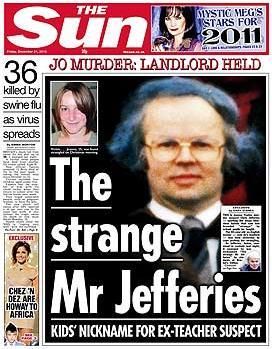 The front page of The Sun showed a small photograph of Joanna Yeates next to a cut-out from a school line-up showing Jefferies 30 years ago, with very blue hair, grinning. The headline was: “The strange Mr Jefferies – Kids’ nickname for ex-teacher suspect”. Then on page four it was dominated by four words, each accompanied by an explanatory phrase, weird: ‘Strange talk, strange walk’, posh:‘Loved culture, poetry’, lewd: ‘Made sexual remarks’, creepy: ‘Loner with blue rinse hair’. The article started by “Joanna Yeates murder suspect Chris Jefferies was last night branded a creepy oddball by ex-pupils, a teaching colleague and neighbours.” It went on to assert that he had a ferocious temper and threw things in the classroom, and that he invited pupils to his home and habitually made sexual remarks. He was also branded as being "unkempt and dirty, a loner, domineering" and generally believed to be a homosexual. The evidence for this came largely from unnamed sources.

The Defamation Act 1996 and 2013
.jpg) The UK Defamation Act 1996, exists to protect the reputation and good standing of an individual. In order to pursue a successful defamation suit the claimant must: prove that they have a reputation which can be damaged and be able to show that their reputation has been damaged. The 1996 version of the act was replaced by the 2013 version which changed a number of Defamation procedures. All defamation cases under the Senior Courts Act 1981 in the Queens Bench Division, and the County Courts Act 1984, which were “tried with a jury”, unless the trial requires prolonged examination of documents &c, are now “tried without a jury” unless the court orders otherwise. Such cases are referred through a Defamation Recognition Commission (DRC) to a new Independent Regulatory Board (IRB), to provide arbitration services. The Courts should take into account, when awarding costs and damages, whether either party in a dispute has chosen not to use the arbitration service. A successful party is required to pay all of the proceedings costs, if such a party unreasonably refused to use the arbitration service. Judgment awards of exemplary damages, where a defendant is guilty of breach of a defendant’s rights, can take into account whether either party refused to use, or join the arbitration service. Courts should take into account whether defendant first sought advice from the IRB before publication. It was changed to give a better protection to people expressing their opinions are to come into force in England and Wales.
The UK Defamation Act 1996, exists to protect the reputation and good standing of an individual. In order to pursue a successful defamation suit the claimant must: prove that they have a reputation which can be damaged and be able to show that their reputation has been damaged. The 1996 version of the act was replaced by the 2013 version which changed a number of Defamation procedures. All defamation cases under the Senior Courts Act 1981 in the Queens Bench Division, and the County Courts Act 1984, which were “tried with a jury”, unless the trial requires prolonged examination of documents &c, are now “tried without a jury” unless the court orders otherwise. Such cases are referred through a Defamation Recognition Commission (DRC) to a new Independent Regulatory Board (IRB), to provide arbitration services. The Courts should take into account, when awarding costs and damages, whether either party in a dispute has chosen not to use the arbitration service. A successful party is required to pay all of the proceedings costs, if such a party unreasonably refused to use the arbitration service. Judgment awards of exemplary damages, where a defendant is guilty of breach of a defendant’s rights, can take into account whether either party refused to use, or join the arbitration service. Courts should take into account whether defendant first sought advice from the IRB before publication. It was changed to give a better protection to people expressing their opinions are to come into force in England and Wales.
Thursday, 20 November 2014
Assignment One – Comparison of Radio News Bulletins
Comparison of Radio News Bulletins
The task we were assigned was to create a detailed and illustrated report on the differences and comparisons of a variety of news bulletins. We have to look closely at the differences in the ‘form’ or ‘treatment’ of news stories and the ‘styles’ in which they are presented. Finally the report should seek to critically compare these bulletins in terms of news values with reference to audience and station’s agenda. The three news bulletins I decided to evaluate were Radio 2, Wave 105 and Capital South Coast. All of them are unique to themselves and each have different elements which are similar as well as different. I choose these three news bulletins as I felt they weren't completely identical; the stories they report vary from local and worldwide, the style of reporting differs from slow paced, more understandable to rapid and prompt. Also the layout of stories told all differ (some radio stations start with sport stories whereas others begin with shocking worldwide stories) and finally the type of readers alter from older more professional people to young, chatty laid-back readers.
 The first news bulletin I evaluated was Radio 2 which is a BBC station. This radio station is apart of the BBC's national radio stations and is one of the most popular station in the whole of United Kingdom. The station is best described as adult contemporary due to most of its daytime playlist-based programming, but also can be distinguished as specialist broadcasting of other musical genres. Radio 2 only broadcasts in the United Kingdom but can be available worldwide through the internet. The station first launched on 30th September 1967 at 5.30 am. It started from the Light Programme with some of Light Programme's music shows transferring to the recent BBC Radio 1 launch. The first show had started at 05:30am (on the Light Programme) but continued with Breakfast Special from Paul Hollingdale as Radio 1 split. The stations audience is mainly adults over the age of 35, around 82% of listeners come under this style. However recently Radio 2 have changed the style of music more to cater for younger listeners The daytime playlist features music from the 60's to more current chart hits, albums and also indie/alternative music. The station has a broad and deep appeal with accessible daytime programmes and specialist programmes of particular types or eras of music. The station even won the Music Week Award for National Radio Station of the Year in 2009, an award which the station has previously won several times which just proves how successful Radio 2 actually is when it comes to musically catering for their audience. The format of Radio 2 is Adult Contemporary Music (AC) which is a style of music, ranging from 1960s vocal and 1970s soft rock music.The station has a catchy slogan "Online, on Digital Radio, and on 88 to 91 FM" which is always used in the news bulletins and has in a way become a recognisable phrase and made the station a household brand. Through my primary research from Radio 2 which I got from emailing the assistant editor in the Radio Newsroom at the BBC, James Hermon. I discovered news on Radio Two has its own style and approach. It is built on the same foundations as all BBC news - impartial, balanced etc. It is Radio 2 direct, with an emphasis on actuality (short clips of people affected by the story - from politicians, to experts, to eye-witnesses) and short clips from correspondent. 2-ways. Brevity is essential. Short sentences - without clauses - should be the ideal. This gives a summary pace and urgency. R2 summaries can be more informal at times - both in terms of writing style and type of story. An important note: radio audiences often listen while doing something else. The stories have to be comprehended instantly, hence the writing style. Another important note: R2 audiences stick to the network - they listen for long stretches of time. We try to vary the lead story - if feasible; and we try to vary the other stories as much as we can - to avoid repetition, and to avoid sounding stale. On story selection, the main emphasis is on what is traditionally called the "human interest" angle. They like to humanise political or social policy stories as much as we can (although, that can be hard to do) by using the voices of real people. For example, if there is an announcement on the use of new cancer drugs, we may use a clip of a trusted expert - a senior public health official or cancer specialist, say, to explain what is happening - but we would aim to follow that with a "case study" - someone who has experience and for whom the new approach
may may a difference, or not.
 The second news bulletin I evaluated was Wave 105 which is a commercial station. The station is a UK regional commercial radio station broadcasting across East Dorset, South Hampshire, Isle of Wight and parts of West Sussex and Wiltshire. It plays a variety of music under the theme of adult contemporary It doesn't just play constant music it has a mixture of presenter-led shows which includes local news/information, entertainment moments and competitions. Wave 105 is entirely locally produced and is a part of the Bauer Place Portfolio. The studio is at Segensworth East in Fareham and broadcasts across the Hampshire area. Wave 105 first broadcasted in 14th of June 1998, with news provided by the station local news team and the combination of Sky News. In December 2013 Wave 105 had their highest listening figures ever, audience research found from RAJAR showed the station had 438,000 people listening and an average of 10.3 hours a week. Meaning 4,520,000 total listening hours weekly which made Wave 105 the commercial leader in the south of England. Their is currently a range of presenters on the station with some of the most popular being Steve Power doing 'Steve Power at Breakfast' every week day between 5.30 am to 9.00 am. Mark Collins who presents 'Mark Collins' Morning Show' and 'The Golden Hour', every week day between 09:00-01:00, with Selina Ross on travel. He also hosts 'FloorFillers' on Saturdays 18:00-00:00 and Saturday Breakfast 07:00-10:00 including The Golden Hour. Wave 105 plays a variety of music but in particular pop music from the 80's and the past decade, the station is aimed at females aged around early 30's which is proven by the style of music. The format of Wave 105 is Adult Contemporary Music (the same as Radio 2) which is mirrored by the style of music. The slogan which is always used in the news bulletins is 'The South's Best Variety of Hits', its noticeable and also makes the audience want to listen to this radio station if its so good as its made out to be.
 The third news bulletin I evaluated was Capital South Coast which is a commercial station. This is a regional radio station owned by Global Radio as apart of the Capital Radio Network. The location it broadcasts is around South Hampshire from the studios in Segensworth Fareham. Captial and Wave are both broadcasted from the same location. Capital South Coast is a station apart of eleven other independent contemporary hit radio stations under the ownership of Global Radio. All of the capital stations combined serve an audience of 7.1 million listeners, making Capital one of the most successful and popular station brands in United Kingdom. Capital was the UK's first national, commercial, hit music radio station. The station was first launched in the South of England in 1975, but under the name of Radio Victory. It only first only transmitted to a small area around Portsmouth before getting an extended license which included Southampton and Winchester. The station went under multiple revamps and getting taken over by a variety of different companies before it was rebranded on the 3rd of January 2011 as part of a merger of Global Radio's Galaxy and Hit Music networks to form the nine-station Capital radio network. The rebranded station kept their popular breakfast presenters Zoe Hanson and Paul Gillies who have know become in a way a household brand as every listeners recognises and relates to the presenters. Capital South Coast has a Contemporary Hit Radio format as the most popular music genre played is current hits, chart music, mostly pop songs or songs from genres like indie or dance but are currently popular in the charts. The target audience for Capital South Coast is the 14-34 year old age group as the presenters mirror this age, the stories told in the news bulletins are ones which would interest this age group and the music they play are aimed at more younger people. The sister stations (radio and/or television stations operated by the same company) of Capital South Coast are Classic FM and Heart Solent. Radio industry statistic measuring website RAJAR says that Capital South Coast has an audience share of 6.4% from June 2013.
The Radio 2 news bulletin was around 5 minutes long, it was aired on the 2nd of September 2013 and the airtime was 8pm. The bulletin began with upbeat, catchy soundbite which immediately catches your attention and in a way uplifts your mood because its so positive and uplifting. This is the only type of music played throughout the bulletin which shows that this radio stations main focus is to purely address news to the audience as clear and understandable as possible. This relates to the target audience of Radio 2 being older people as stereotypically they are more interested in news and need to hear it as clearly as possible. The presenter introduces the news bulletin by saying the radios stations name, the time and the day which is just a good way to start a bulletin rather than straightaway start discussing multiple stories. He also says 'good morning' which is formal but chatty way to directly inform the listeners and make them feel welcomed and actually important; it makes you feel as if the station want you to hear these stories as its more addressing then just someone speaking about loads of stories for 5 minutes. One thing which the presenter didn't do was actually introduce themselves, by doing this it would make it seem more personal and the listeners would tend to find further reliable. The first story was about US President Barack Obama which although has a lot of public interest as Obama is a very important public figure isn't local or national news but rather world. The story was about Barack Obama launching an intense lobbying effort to win congressional support for US military intervention in Syria. It's the main story and later discussed further in the news bulletin. The second story was a mixture between local and national as it refers to GCSE exams and the fact student would be faced with retaking papers if they don't achieve a minimum standard. This story would interest the listeners as the average audience is 35 year olds and over who a lot of them would have children so a story about schools and GCSE's is attention-grabbing. The third story is about scientists believing European men have grown four inches taller in a century, this story isn't breaking news and if somebody didn't hear about it then it wouldn't particularly matter but on the other hand is interesting and adds a lighthearted element to the news bulletin. Stories like this are usually used as a break between hard hitting stories; if a news bulletin was filled with really upsetting and distressing stories it could be slightly overwhelming so the use of laid-back stories makes it more relaxed. However this particular story would interest the average audience, one it being over 35 year olds but also the fact Radio 2 is aimed at males which the story is about; it doesn't refer to females height increasing purely just males so would engage the audience. The presenter then refers back to the first story which suggest the first three stories told were the main stories. It goes into more depth and detail not just referring to what Obama said but also other people, its a lot more informative and caters for people wanting to hear more knowledge about the story. Statistics and facts were also used which makes it seem more intelligent. During the bulletin a lead-in is used where the presenter switches over to Mark Mardell from Washington who is a presenter for The World This Weekend and correspondent, using someone like this makes the story seem more trustworthy and believable as the listeners are hearing first hand knowledge from somebody who has expert understanding. The presenter then refers back to the second story and again in more detail, the presenter refers to quotes from important people like ministers which adds more depth to the stories. Then uses a lead-in to an educational correspondent where they share more information and gives their personal view on the story. An educational correspondent is seen as expert on the topic which is better than just using the presenter as they know more about the area; more information means more believable. The presenter then starts discussing new stories which the listeners hadn't already heard. The first new story was about an arrest of five teenage boys after an arson attack which destroyed Lancashire College on the eve of the first day back of term. This stories wasn't discussed in great detail which suggests it's a recent story with a lack of information, it also doesn't use any lead-ins, experts or soundbites. The second new story was about TUC lodges complaints against the government for failing to give equal pay to agency workers. This story would engage the average audience as the age of agency workers are similar to the age of radio 2 listeners. Also any news which refers to the government usually would be public interest for middle aged people. The presenter leads on to a business correspondent who has expert knowledge on the topic which makes the story more interesting as it doesn't just have the presenter discussing it. The business correspondent also refers to the publics opinion which allows the listeners to relate. The next story is about Vodafone selling 45% interest in the company for $130 billion to Verizon, this story would aim at the more younger audience as they stereotypically have more of an interest in technology. The news bulletin then refers back to the story about European men growing 4 inches taller in 100 years. Two lead-in's are used as expert Timothy Hatton, Professor of Economics at the University of Essex discusses the story in more detail, then switches to Sue Gardner who adds a personal element by referring to an actual person who proves the scientific theory. By using these experts it makes the story more engaging and allows the listeners to understand more information. The final story which is in the Radio 2 news bulletin is about global warming and how crop pests and diseases are moving towards the poles due to the warmer temperatures. The story purely has the presenter talking about as it not specifically public interest but purely used to nicely end the news bulletin on a topic which is serious but not harrowing. The final part of the bulletin uses a lead-in to a weather broadcaster where they discuss the weather forecast, nearly all news bulletins will discuss weather at some point as its something which the listeners usually want to be aware of. The news presenter ends the bulletin by saying 'and thats the bbc news, its 5 past 8', this is a good way of ending the news as its personal but still formal (like the style of Radio 2) and allows the audience to feel like they've been directly addressed. Through my primary research I emailed Bob Shennan who is a British radio executive and Controller of BBC Radio 2 and BBC Radio 6 Music. I got a response back from James Hermon who is an assistant editor in the Radio Newsroom at the BBC. James Hermon told me the following information; the Radio Newsroom provides the news on the hour for Radio 2, Radio 4, 6 Music and more than 40 local radio stations. They also write morning, lunchtime and evening summaries for Radio 3. Every hour of every day, one of our journalists is producing news for at least one of those networks. The biggest audiences are on Radio 2 and the biggest single piece of journalism is the Six O’Clock News on Radio 4 every evening. He also told me the news output on Radio Two is as follows: three minute summaries on the hour, with three pieces of audio, and, ideally seven stories. The bulletins at 8am, 9am, 1pm and 5pm are five minutes long. The summary forms what is known as "the rip and read" - the news sent out, at twenty to the hour, to every BBC local station. More than 12 million listeners. That's roughly one-in-five of the population. And that's in a media world that is fragmented and becoming increasingly customised as a result of the internet. A sizeable chunk of the population is choosing to listen in to Radio Two. It would suggest, from a news perspective, one reason is because it is familiar and trusted.
The Wave 105 news bulletin was around 3 minutes long, it was aired on the 2nd of September and the airtime 8pm. The bulletin began in a similar way to Radio 2 with a lively and energetic soundbite, through the soundbite a voice-over says the radio stations slogan 'on fm, on digital and online, the south coasts biggest radio station... Wave 105' which straight away addresses the listeners and tell them what station it is but also gives them confidence that they have chosen a good and successful radio station to be informed by. The radio presenter then makes her introduction with 'It's 8 o clock, I'm Liz Allaway', this is something Radio 2 didn't. Although in the first news bulletin the presenter did inform the listeners with the time of day but not the presenters name. By Wave 105 having the presenter introduce themselves it makes it more personal and trustworthy as your more likely to believe what people say if you have some personal information about them. The first news story which is discussed is national and about the death of Sir David Frost. This story would have a lot of public interest as Sir David Frost was a very well known public figure. The presenter discusses it in great detail by informing the listeners how he died 'Veteran broadcaster Sir David Frost has died from a heart attack while on a luxury liner from Southampton to Lisbon – far from specialised medical assistance.' The presenter uses a lead-in to friend of Sir David Frost, British journalist and television presenter Esther Rantzen who further discusses the sad death by talking about personal moments 'he was an extraordinary man, he loved communicating and never had take skin or a mask off he was who he was'. This could be seen as a Vox Pop. Or though the listeners wouldn't need to know this information it adds a more respective touch and allows the audience to relate to this saddening death. The second story is about the Prime Minister David Cameron's pressure mounting to call a second vote military action against Syria, this story goes into great detail as its a story which has a lot of public interest. In the Radio 2 news bulletin the presenter only spoke about US President Barack Obama's recent updates regarding Syria and not anything about David Camerons. Whereas Wave 105 discussed both, using national and world news. The presenter uses a lead-in to Boris Johnson (Mayor of London) where he further discusses the story, due to it being such public interest as it affects pretty much everyone in the country it would be the main story which goes into such depth. The next story is lead up from the one previous as it was about Barack Obama launching an intense lobbying effort to win congressional support for US military intervention in Syria, which is the same story as Radio 2 so shows that although both stations may have different target audiences a story which involves the government has public interest to everyone. The presenter uses a lead-in to Republican center Michael Burgess who allows the audience to have there own opinion on the topic as it gives a flip side to the story by not completely agreeing with Obama. This makes the article less bias as it adds a different element to the story. The next story is local, which is the first local story discussed in the news bulletin. Its about a 53 year motor cyclist dying on the A350, which is an A3 in the area in which Wave 105 is broadcasted so would be a big interest to the listeners. It goes into great detail by describing the incident, the people involved and sadly confirming the death. Although this story is extremely upsetting it wouldn't be in news bulletin which doesn't specifically cover that local area as hundreds of people die everyday in car accidents which is why they can't be spoken about in every news bulletin. This is probably reason it wasn't discussed in Radio 2. The next story is also local and is about a protester dressed as Spiderman causes Wessex Way to close on the last day of Air Festival. The presenter said that the A338 was closed in both directions by police after responding to reports of a man dressed as Spiderman hanging from the flyover. Both these stories are local which would have a lot of interest with the listeners as people like to be aware of world, national but also local news. The next story is about free childcare for families earning less than £16,190 a year, its only discussed by the presenter but uses quotes from Deputy Prime Minister Nick Clegg which adds believability as it uses an important source. The next story is about thousands of registers being sold to pizza delivery shops, estate agents and marketing firms over the past five years. The presenter refers to privacy campaigner Nick Pickles who gives his expert knowledge and opinion on the topic; this adds depth to the story and makes it more interesting. The last story is about the Bournemouth Air Festival, the presenter goes into great detail, discussing the event and some of the highs and lows throughout. By ending the news bulletin with this story makes it seem positive and optimistic, also using a local story finishes the bulletin in a personal way; its about something which is closer to home and the listeners can relate. The bulletin ends with the presenter saying 'for the latest updates follow our twitter @wave105' by the presenter saying this it aims it more at a younger audience as younger people use social media a lot, and in this day and age the majority of media platforms like television and radio will use some form of social media to connect with the youth. The only soundbites used were at the beginning and at the end which were both energetic guitar sounds that make the news bulletin more lively and upbeat. The Wave 105 news bulletin was a lot of different to Radio 2 as it was more fast paced and quick. The presenter told the stories in a faster way and in slightly less detail which suggest that the audience for Wave 105 aren't as interested as hearing every single piece of information like Radio 2. The first news bulletin was a lot more slower and the presenter spoke in more understable voice which could be due to the audience of Radio 2 being older and needing to understand the presenter more. The type of stories in Radio 2 weren't so local as the majority of them were national or world, this is because Radio 2 doesn't broadcast to just a certain area as it broadcasts the whole of United Kingdom. Whereas Wave 105 discuss more local stories as it only broadcasts around the South Hampshire area.
The final bulletin I looked at was Capital South Coast which was around 2 minutes long. The bulletin started in a similar way to Radio 2 and Wave 105 with upbeat, happy music and then introducing the radio station. A voiceover was used to introduce the radio station by saying 'Capital Breakfast', the presenter doesn't introduce themselves or say the actual name of the radio station like Wave 105 but rather goes straight into informing the listeners with news. This was done because this bulletin is only 2 minutes long so needs the all the time needs to be used on the different stories, this is also why they wouldn't be as many stories or said in great detail. The first story is about sport and Gareth Bale becoming the most expensive football player in the world after moving from Tottenham to Real Madrid for £85.3 million. News bulletins don't usually tend to start with sport stories as only a certain part of the audience would be interested in it. Also the first stories of news bulletin usually are headline hitting or of immense public interest. Capital South Coast is the only news bulletin which discusses a sports story which could suggest as the audience age group is 14-34 year olds they'd be mostly likely interested in a hearing a story of this style rather than a murder investigation. The second story which was also used in Wave 105 was national and about pressure mounting David Cameron to call second vote on military action against Syria. It's an important story and something which has interest to all ages as it has an effect on everyone which is why it was featured on all three of the news bulletins. The presenter uses a lead-in to British politician Michael Thomas Hancock who adds relevancy to the story and make it more understandable as its not just being told by the presenter. The next story is another political story and is world news. The story is about US President Barack Obama launching an intense lobbying effort to win congressional support for US military intervention in Syria. This story is a lead up from the one before that which makes people understand the situation with the government and Syria. This is another story which was in the Radio 2 and Wave 105 news bulletin, its a public interest story which is why its widely discussed. The next story is national and about Two Coronation Street actors in court accused of separate sexual offence chargers against children. One being Michael Le Vell going to trial and Bill Roache due before magistrate. The story would interest the listeners as people between the age of 14-34 tend to watch Coronation Street so a shocking story like this would engage them. This story wasn't spoken about in any other news bulletin even though its a national scandalous story but most likely because its not aimed at Radio 2 or Wave 105's audience. The next story refers to politicians and celebrities playing tributes to Sir David Frost, Capital South Coast doesn't go into as much detail as Wave 105 or uses any lead-ins. This was because Capital South Coast only had a 2 minute bulletin which is why it couldn't go into as much depth. The last article was about the musical Wicked coming to Southampton in Mayflower Theatre between October and November 2014. This story is the only one which is local and would interest the audience as its the type of musical more younger people would want to see. The news bulletin ends with a cheery and youthful soundbite before a weather reporter starts addressing the weather which is sponsored by Kleenex Balsam tissues. Capital South Coast's news bulletin is the most different out of the three as one its a lot shorter; Radio 2's news bulletin was double the length of Capital. The last news bulletin also didn't go into as much detail with their stories and most of them were discussed in overview style by just reporting the main parts. Capital also only reported on one local story whereas Wave 105 reported on near 5 or 6. Radio 2 and Wave 105 had the most similar type of stories as they reported on a mixture of world, local and national. Wave 105 and Capital South Coast had a very similar style of reporting; both of the presenters reported in a more chatty and informal way unlike Radio 2. Capital South Coast's new bulletin was very fast and the presenter didn't speak as fluently as Radio 2's presenter because in Capitals bulletin the presenter had two minutes to inform the audience on as many stories as Radio 2 had in five minutes.
Radio 2, Wave 105 and Capital South Coast all connect with their audiences in different ways. As Radio 2 is a BBC station its apart of the BBC Trust, which is created for BBC viewers, listeners and user to rely on to reflect the many communities that exist in the UK. These communities may be based on geography, on faith, on language, or on a shared interest such as sport. The BBC will stimulate debate within and between the communities of the UK, and encourage people to get involved with their local communities. The BBC Trust's priorities is split into six specific areas which is to represent the different nations, regions and communities to the rest of the UK, cater for the different nations, regions and communities of the UK, bring people together for shared experiences, encourage interest in and conversation about local communities, reflect the different religious and other beliefs in the UK and provide output in minority languages. Radio 2 connects with the audience by following the rules of the BBC Trust and ensuring a rounded representation of the nations on regions on the news is done. On the BBC's official website under the section of 'Inside the BBC' I found out the BBC's network news output will effectively report the changing face of the UK and the realities of devolution. It also will reflect perspectives from across the nations and regions and explain policy differences. The BBC has worked harder in the recent years to improve the accuracy, balance and relevance of its UK-wide news coverage. From my primary found from James Hermon he told me that the average listener is 51. Almost a half of Jeremy Vine's audience, for example, is over 55. Roughly 41 per cent of the audience is aged between 35 and 54. Most listeners live in the south of England. They are likely to read newspapers such as the Daily Mail and the Sun. I researched Radio 2's audience and found statistics published by RAHAR. In a year the station weekly audience grew to 14.94 million, from 13.90m and a record 15.44m last quarter. The station also had a share of 16.9% from 15.6 last year and 17.2% last quarter. Further more The Chris Evans Breakfast Show drew an audience of 9.35 million listeners every week – compared to 8.55m last year and 9.75m last quarter. Wave 105 connects with their audiences through competitions and presenter led shows which involve the listeners. Radio 2 which rather focuses more on music then competitions and presenter shows (which they still do just not as much as Wave 105) is different to Wave 105 as the majority of the radio air time embrace multiple different competitions and presenter led shows. By using these techniques it creates money for the station as the more people who enter the competition the more money is being made, but it also gets the audience involved and creates greater popularity for Wave 105. I researched Wave 105's audience by using media statistic website 'Media.Info' which showed me 50.3% of the stations listeners are females and 49.7% are males. The most popular age range for listeners is 25 to 55 year olds which is aimed at more older people than Capital South Coast. I also discovered the total listeners per week is 360,000, per listeners listens to 12 hours per week, total hours listened per week is 4,325,00, the market share is 11.8% and the total population covered is 1,811,000. Capital South Coast connects with their audiences through a similar way to Wave 105; competitions and presenter led shows which involve the listeners. Capital South Coast's audience tune into the radio station for the music and the brands lifestyle. They are a mainstream early majority audience which will always be among the first to know about new hit music which is why Capital South Coast uses this to their advantage by connecting with them through playing the latest and current hits. I researched Capital South Coast's audiences and found the company which owns the radio stations website (http://www.thisisglobal.com) which informed me with information regarding Capital South Coast. The radio station is owned by Global, which also owns Heart, Classic FM and Gold. I found out the majority of the audience is female with 58% over 42% males and 59% of the listeners are between the age of 14-34 year olds. Capital listeners would be huge fans of popular music entertainment, very media savvy/ and on trend with celebrities which is why Capital South Coast would connect with the audience by keeping the updated with the latest glamour, glitz and gossip. Through research from RAJAR I also discovered Capital South Coast has increased its market share from 4.9% to 5.5%. and Gillies and Emily at breakfast have increased their reach quarter on quarter to 113,000.
Bibliography
Website
Breaking news
WIKIPEDIA
Breaking news
In-text: (Wikipedia)
Bibliography: Wikipedia,. 'Breaking News'. N.p., 2015. Web. 12 Feb. 2015.
Website
BBC - Radio 2 - Home
BBC.CO.UK
BBC - Radio 2 - Home
In-text: (Bbc.co.uk)
Bibliography: Bbc.co.uk,. 'BBC - Radio 2 - Home'. N.p., 2015. Web. 12 Feb. 2015.
BBC Radio 2
WIKIPEDIA
BBC Radio 2
In-text: (Wikipedia)
Bibliography: Wikipedia,. 'BBC Radio 2'. N.p., 2015. Web. 12 Feb. 2015.
Adult Contemporary Music Chart | Billboard
BILLBOARD
Adult Contemporary Music Chart | Billboard
In-text: (Billboard)
Bibliography: Billboard,. 'Adult Contemporary Music Chart | Billboard'. N.p., 2015. Web. 12 Feb. 2015.
CAPITAL
Capitalfm.com
In-text: (Capital)
Bibliography: Capital,. 'Capitalfm.Com'. N.p., 2015. Web. 12 Feb. 2015.
Capital FM
WIKIPEDIA
Capital FM
In-text: (Wikipedia)
Bibliography: Wikipedia,. 'Capital FM'. N.p., 2015. Web. 12 Feb. 2015.
Wave 105
WIKIPEDIA
Wave 105
In-text: (Wikipedia)
Bibliography: Wikipedia,. 'Wave 105'. N.p., 2015. Web. 12 Feb. 2015.
WAVE 105
In-text: (Wave 105)
Bibliography: Wave 105,. 'Wave 105'. N.p., 2015. Web. 12 Feb. 2015.
RAJAR.CO.UK
RAJAR
In-text: (Rajar.co.uk)
Bibliography: Rajar.co.uk,. 'RAJAR'. N.p., 2015. Web. 12 Feb. 2015.
The task we were assigned was to create a detailed and illustrated report on the differences and comparisons of a variety of news bulletins. We have to look closely at the differences in the ‘form’ or ‘treatment’ of news stories and the ‘styles’ in which they are presented. Finally the report should seek to critically compare these bulletins in terms of news values with reference to audience and station’s agenda. The three news bulletins I decided to evaluate were Radio 2, Wave 105 and Capital South Coast. All of them are unique to themselves and each have different elements which are similar as well as different. I choose these three news bulletins as I felt they weren't completely identical; the stories they report vary from local and worldwide, the style of reporting differs from slow paced, more understandable to rapid and prompt. Also the layout of stories told all differ (some radio stations start with sport stories whereas others begin with shocking worldwide stories) and finally the type of readers alter from older more professional people to young, chatty laid-back readers.

may may a difference, or not.

 The third news bulletin I evaluated was Capital South Coast which is a commercial station. This is a regional radio station owned by Global Radio as apart of the Capital Radio Network. The location it broadcasts is around South Hampshire from the studios in Segensworth Fareham. Captial and Wave are both broadcasted from the same location. Capital South Coast is a station apart of eleven other independent contemporary hit radio stations under the ownership of Global Radio. All of the capital stations combined serve an audience of 7.1 million listeners, making Capital one of the most successful and popular station brands in United Kingdom. Capital was the UK's first national, commercial, hit music radio station. The station was first launched in the South of England in 1975, but under the name of Radio Victory. It only first only transmitted to a small area around Portsmouth before getting an extended license which included Southampton and Winchester. The station went under multiple revamps and getting taken over by a variety of different companies before it was rebranded on the 3rd of January 2011 as part of a merger of Global Radio's Galaxy and Hit Music networks to form the nine-station Capital radio network. The rebranded station kept their popular breakfast presenters Zoe Hanson and Paul Gillies who have know become in a way a household brand as every listeners recognises and relates to the presenters. Capital South Coast has a Contemporary Hit Radio format as the most popular music genre played is current hits, chart music, mostly pop songs or songs from genres like indie or dance but are currently popular in the charts. The target audience for Capital South Coast is the 14-34 year old age group as the presenters mirror this age, the stories told in the news bulletins are ones which would interest this age group and the music they play are aimed at more younger people. The sister stations (radio and/or television stations operated by the same company) of Capital South Coast are Classic FM and Heart Solent. Radio industry statistic measuring website RAJAR says that Capital South Coast has an audience share of 6.4% from June 2013.
The Radio 2 news bulletin was around 5 minutes long, it was aired on the 2nd of September 2013 and the airtime was 8pm. The bulletin began with upbeat, catchy soundbite which immediately catches your attention and in a way uplifts your mood because its so positive and uplifting. This is the only type of music played throughout the bulletin which shows that this radio stations main focus is to purely address news to the audience as clear and understandable as possible. This relates to the target audience of Radio 2 being older people as stereotypically they are more interested in news and need to hear it as clearly as possible. The presenter introduces the news bulletin by saying the radios stations name, the time and the day which is just a good way to start a bulletin rather than straightaway start discussing multiple stories. He also says 'good morning' which is formal but chatty way to directly inform the listeners and make them feel welcomed and actually important; it makes you feel as if the station want you to hear these stories as its more addressing then just someone speaking about loads of stories for 5 minutes. One thing which the presenter didn't do was actually introduce themselves, by doing this it would make it seem more personal and the listeners would tend to find further reliable. The first story was about US President Barack Obama which although has a lot of public interest as Obama is a very important public figure isn't local or national news but rather world. The story was about Barack Obama launching an intense lobbying effort to win congressional support for US military intervention in Syria. It's the main story and later discussed further in the news bulletin. The second story was a mixture between local and national as it refers to GCSE exams and the fact student would be faced with retaking papers if they don't achieve a minimum standard. This story would interest the listeners as the average audience is 35 year olds and over who a lot of them would have children so a story about schools and GCSE's is attention-grabbing. The third story is about scientists believing European men have grown four inches taller in a century, this story isn't breaking news and if somebody didn't hear about it then it wouldn't particularly matter but on the other hand is interesting and adds a lighthearted element to the news bulletin. Stories like this are usually used as a break between hard hitting stories; if a news bulletin was filled with really upsetting and distressing stories it could be slightly overwhelming so the use of laid-back stories makes it more relaxed. However this particular story would interest the average audience, one it being over 35 year olds but also the fact Radio 2 is aimed at males which the story is about; it doesn't refer to females height increasing purely just males so would engage the audience. The presenter then refers back to the first story which suggest the first three stories told were the main stories. It goes into more depth and detail not just referring to what Obama said but also other people, its a lot more informative and caters for people wanting to hear more knowledge about the story. Statistics and facts were also used which makes it seem more intelligent. During the bulletin a lead-in is used where the presenter switches over to Mark Mardell from Washington who is a presenter for The World This Weekend and correspondent, using someone like this makes the story seem more trustworthy and believable as the listeners are hearing first hand knowledge from somebody who has expert understanding. The presenter then refers back to the second story and again in more detail, the presenter refers to quotes from important people like ministers which adds more depth to the stories. Then uses a lead-in to an educational correspondent where they share more information and gives their personal view on the story. An educational correspondent is seen as expert on the topic which is better than just using the presenter as they know more about the area; more information means more believable. The presenter then starts discussing new stories which the listeners hadn't already heard. The first new story was about an arrest of five teenage boys after an arson attack which destroyed Lancashire College on the eve of the first day back of term. This stories wasn't discussed in great detail which suggests it's a recent story with a lack of information, it also doesn't use any lead-ins, experts or soundbites. The second new story was about TUC lodges complaints against the government for failing to give equal pay to agency workers. This story would engage the average audience as the age of agency workers are similar to the age of radio 2 listeners. Also any news which refers to the government usually would be public interest for middle aged people. The presenter leads on to a business correspondent who has expert knowledge on the topic which makes the story more interesting as it doesn't just have the presenter discussing it. The business correspondent also refers to the publics opinion which allows the listeners to relate. The next story is about Vodafone selling 45% interest in the company for $130 billion to Verizon, this story would aim at the more younger audience as they stereotypically have more of an interest in technology. The news bulletin then refers back to the story about European men growing 4 inches taller in 100 years. Two lead-in's are used as expert Timothy Hatton, Professor of Economics at the University of Essex discusses the story in more detail, then switches to Sue Gardner who adds a personal element by referring to an actual person who proves the scientific theory. By using these experts it makes the story more engaging and allows the listeners to understand more information. The final story which is in the Radio 2 news bulletin is about global warming and how crop pests and diseases are moving towards the poles due to the warmer temperatures. The story purely has the presenter talking about as it not specifically public interest but purely used to nicely end the news bulletin on a topic which is serious but not harrowing. The final part of the bulletin uses a lead-in to a weather broadcaster where they discuss the weather forecast, nearly all news bulletins will discuss weather at some point as its something which the listeners usually want to be aware of. The news presenter ends the bulletin by saying 'and thats the bbc news, its 5 past 8', this is a good way of ending the news as its personal but still formal (like the style of Radio 2) and allows the audience to feel like they've been directly addressed. Through my primary research I emailed Bob Shennan who is a British radio executive and Controller of BBC Radio 2 and BBC Radio 6 Music. I got a response back from James Hermon who is an assistant editor in the Radio Newsroom at the BBC. James Hermon told me the following information; the Radio Newsroom provides the news on the hour for Radio 2, Radio 4, 6 Music and more than 40 local radio stations. They also write morning, lunchtime and evening summaries for Radio 3. Every hour of every day, one of our journalists is producing news for at least one of those networks. The biggest audiences are on Radio 2 and the biggest single piece of journalism is the Six O’Clock News on Radio 4 every evening. He also told me the news output on Radio Two is as follows: three minute summaries on the hour, with three pieces of audio, and, ideally seven stories. The bulletins at 8am, 9am, 1pm and 5pm are five minutes long. The summary forms what is known as "the rip and read" - the news sent out, at twenty to the hour, to every BBC local station. More than 12 million listeners. That's roughly one-in-five of the population. And that's in a media world that is fragmented and becoming increasingly customised as a result of the internet. A sizeable chunk of the population is choosing to listen in to Radio Two. It would suggest, from a news perspective, one reason is because it is familiar and trusted.
The Wave 105 news bulletin was around 3 minutes long, it was aired on the 2nd of September and the airtime 8pm. The bulletin began in a similar way to Radio 2 with a lively and energetic soundbite, through the soundbite a voice-over says the radio stations slogan 'on fm, on digital and online, the south coasts biggest radio station... Wave 105' which straight away addresses the listeners and tell them what station it is but also gives them confidence that they have chosen a good and successful radio station to be informed by. The radio presenter then makes her introduction with 'It's 8 o clock, I'm Liz Allaway', this is something Radio 2 didn't. Although in the first news bulletin the presenter did inform the listeners with the time of day but not the presenters name. By Wave 105 having the presenter introduce themselves it makes it more personal and trustworthy as your more likely to believe what people say if you have some personal information about them. The first news story which is discussed is national and about the death of Sir David Frost. This story would have a lot of public interest as Sir David Frost was a very well known public figure. The presenter discusses it in great detail by informing the listeners how he died 'Veteran broadcaster Sir David Frost has died from a heart attack while on a luxury liner from Southampton to Lisbon – far from specialised medical assistance.' The presenter uses a lead-in to friend of Sir David Frost, British journalist and television presenter Esther Rantzen who further discusses the sad death by talking about personal moments 'he was an extraordinary man, he loved communicating and never had take skin or a mask off he was who he was'. This could be seen as a Vox Pop. Or though the listeners wouldn't need to know this information it adds a more respective touch and allows the audience to relate to this saddening death. The second story is about the Prime Minister David Cameron's pressure mounting to call a second vote military action against Syria, this story goes into great detail as its a story which has a lot of public interest. In the Radio 2 news bulletin the presenter only spoke about US President Barack Obama's recent updates regarding Syria and not anything about David Camerons. Whereas Wave 105 discussed both, using national and world news. The presenter uses a lead-in to Boris Johnson (Mayor of London) where he further discusses the story, due to it being such public interest as it affects pretty much everyone in the country it would be the main story which goes into such depth. The next story is lead up from the one previous as it was about Barack Obama launching an intense lobbying effort to win congressional support for US military intervention in Syria, which is the same story as Radio 2 so shows that although both stations may have different target audiences a story which involves the government has public interest to everyone. The presenter uses a lead-in to Republican center Michael Burgess who allows the audience to have there own opinion on the topic as it gives a flip side to the story by not completely agreeing with Obama. This makes the article less bias as it adds a different element to the story. The next story is local, which is the first local story discussed in the news bulletin. Its about a 53 year motor cyclist dying on the A350, which is an A3 in the area in which Wave 105 is broadcasted so would be a big interest to the listeners. It goes into great detail by describing the incident, the people involved and sadly confirming the death. Although this story is extremely upsetting it wouldn't be in news bulletin which doesn't specifically cover that local area as hundreds of people die everyday in car accidents which is why they can't be spoken about in every news bulletin. This is probably reason it wasn't discussed in Radio 2. The next story is also local and is about a protester dressed as Spiderman causes Wessex Way to close on the last day of Air Festival. The presenter said that the A338 was closed in both directions by police after responding to reports of a man dressed as Spiderman hanging from the flyover. Both these stories are local which would have a lot of interest with the listeners as people like to be aware of world, national but also local news. The next story is about free childcare for families earning less than £16,190 a year, its only discussed by the presenter but uses quotes from Deputy Prime Minister Nick Clegg which adds believability as it uses an important source. The next story is about thousands of registers being sold to pizza delivery shops, estate agents and marketing firms over the past five years. The presenter refers to privacy campaigner Nick Pickles who gives his expert knowledge and opinion on the topic; this adds depth to the story and makes it more interesting. The last story is about the Bournemouth Air Festival, the presenter goes into great detail, discussing the event and some of the highs and lows throughout. By ending the news bulletin with this story makes it seem positive and optimistic, also using a local story finishes the bulletin in a personal way; its about something which is closer to home and the listeners can relate. The bulletin ends with the presenter saying 'for the latest updates follow our twitter @wave105' by the presenter saying this it aims it more at a younger audience as younger people use social media a lot, and in this day and age the majority of media platforms like television and radio will use some form of social media to connect with the youth. The only soundbites used were at the beginning and at the end which were both energetic guitar sounds that make the news bulletin more lively and upbeat. The Wave 105 news bulletin was a lot of different to Radio 2 as it was more fast paced and quick. The presenter told the stories in a faster way and in slightly less detail which suggest that the audience for Wave 105 aren't as interested as hearing every single piece of information like Radio 2. The first news bulletin was a lot more slower and the presenter spoke in more understable voice which could be due to the audience of Radio 2 being older and needing to understand the presenter more. The type of stories in Radio 2 weren't so local as the majority of them were national or world, this is because Radio 2 doesn't broadcast to just a certain area as it broadcasts the whole of United Kingdom. Whereas Wave 105 discuss more local stories as it only broadcasts around the South Hampshire area.
The final bulletin I looked at was Capital South Coast which was around 2 minutes long. The bulletin started in a similar way to Radio 2 and Wave 105 with upbeat, happy music and then introducing the radio station. A voiceover was used to introduce the radio station by saying 'Capital Breakfast', the presenter doesn't introduce themselves or say the actual name of the radio station like Wave 105 but rather goes straight into informing the listeners with news. This was done because this bulletin is only 2 minutes long so needs the all the time needs to be used on the different stories, this is also why they wouldn't be as many stories or said in great detail. The first story is about sport and Gareth Bale becoming the most expensive football player in the world after moving from Tottenham to Real Madrid for £85.3 million. News bulletins don't usually tend to start with sport stories as only a certain part of the audience would be interested in it. Also the first stories of news bulletin usually are headline hitting or of immense public interest. Capital South Coast is the only news bulletin which discusses a sports story which could suggest as the audience age group is 14-34 year olds they'd be mostly likely interested in a hearing a story of this style rather than a murder investigation. The second story which was also used in Wave 105 was national and about pressure mounting David Cameron to call second vote on military action against Syria. It's an important story and something which has interest to all ages as it has an effect on everyone which is why it was featured on all three of the news bulletins. The presenter uses a lead-in to British politician Michael Thomas Hancock who adds relevancy to the story and make it more understandable as its not just being told by the presenter. The next story is another political story and is world news. The story is about US President Barack Obama launching an intense lobbying effort to win congressional support for US military intervention in Syria. This story is a lead up from the one before that which makes people understand the situation with the government and Syria. This is another story which was in the Radio 2 and Wave 105 news bulletin, its a public interest story which is why its widely discussed. The next story is national and about Two Coronation Street actors in court accused of separate sexual offence chargers against children. One being Michael Le Vell going to trial and Bill Roache due before magistrate. The story would interest the listeners as people between the age of 14-34 tend to watch Coronation Street so a shocking story like this would engage them. This story wasn't spoken about in any other news bulletin even though its a national scandalous story but most likely because its not aimed at Radio 2 or Wave 105's audience. The next story refers to politicians and celebrities playing tributes to Sir David Frost, Capital South Coast doesn't go into as much detail as Wave 105 or uses any lead-ins. This was because Capital South Coast only had a 2 minute bulletin which is why it couldn't go into as much depth. The last article was about the musical Wicked coming to Southampton in Mayflower Theatre between October and November 2014. This story is the only one which is local and would interest the audience as its the type of musical more younger people would want to see. The news bulletin ends with a cheery and youthful soundbite before a weather reporter starts addressing the weather which is sponsored by Kleenex Balsam tissues. Capital South Coast's news bulletin is the most different out of the three as one its a lot shorter; Radio 2's news bulletin was double the length of Capital. The last news bulletin also didn't go into as much detail with their stories and most of them were discussed in overview style by just reporting the main parts. Capital also only reported on one local story whereas Wave 105 reported on near 5 or 6. Radio 2 and Wave 105 had the most similar type of stories as they reported on a mixture of world, local and national. Wave 105 and Capital South Coast had a very similar style of reporting; both of the presenters reported in a more chatty and informal way unlike Radio 2. Capital South Coast's new bulletin was very fast and the presenter didn't speak as fluently as Radio 2's presenter because in Capitals bulletin the presenter had two minutes to inform the audience on as many stories as Radio 2 had in five minutes.
Radio 2, Wave 105 and Capital South Coast all connect with their audiences in different ways. As Radio 2 is a BBC station its apart of the BBC Trust, which is created for BBC viewers, listeners and user to rely on to reflect the many communities that exist in the UK. These communities may be based on geography, on faith, on language, or on a shared interest such as sport. The BBC will stimulate debate within and between the communities of the UK, and encourage people to get involved with their local communities. The BBC Trust's priorities is split into six specific areas which is to represent the different nations, regions and communities to the rest of the UK, cater for the different nations, regions and communities of the UK, bring people together for shared experiences, encourage interest in and conversation about local communities, reflect the different religious and other beliefs in the UK and provide output in minority languages. Radio 2 connects with the audience by following the rules of the BBC Trust and ensuring a rounded representation of the nations on regions on the news is done. On the BBC's official website under the section of 'Inside the BBC' I found out the BBC's network news output will effectively report the changing face of the UK and the realities of devolution. It also will reflect perspectives from across the nations and regions and explain policy differences. The BBC has worked harder in the recent years to improve the accuracy, balance and relevance of its UK-wide news coverage. From my primary found from James Hermon he told me that the average listener is 51. Almost a half of Jeremy Vine's audience, for example, is over 55. Roughly 41 per cent of the audience is aged between 35 and 54. Most listeners live in the south of England. They are likely to read newspapers such as the Daily Mail and the Sun. I researched Radio 2's audience and found statistics published by RAHAR. In a year the station weekly audience grew to 14.94 million, from 13.90m and a record 15.44m last quarter. The station also had a share of 16.9% from 15.6 last year and 17.2% last quarter. Further more The Chris Evans Breakfast Show drew an audience of 9.35 million listeners every week – compared to 8.55m last year and 9.75m last quarter. Wave 105 connects with their audiences through competitions and presenter led shows which involve the listeners. Radio 2 which rather focuses more on music then competitions and presenter shows (which they still do just not as much as Wave 105) is different to Wave 105 as the majority of the radio air time embrace multiple different competitions and presenter led shows. By using these techniques it creates money for the station as the more people who enter the competition the more money is being made, but it also gets the audience involved and creates greater popularity for Wave 105. I researched Wave 105's audience by using media statistic website 'Media.Info' which showed me 50.3% of the stations listeners are females and 49.7% are males. The most popular age range for listeners is 25 to 55 year olds which is aimed at more older people than Capital South Coast. I also discovered the total listeners per week is 360,000, per listeners listens to 12 hours per week, total hours listened per week is 4,325,00, the market share is 11.8% and the total population covered is 1,811,000. Capital South Coast connects with their audiences through a similar way to Wave 105; competitions and presenter led shows which involve the listeners. Capital South Coast's audience tune into the radio station for the music and the brands lifestyle. They are a mainstream early majority audience which will always be among the first to know about new hit music which is why Capital South Coast uses this to their advantage by connecting with them through playing the latest and current hits. I researched Capital South Coast's audiences and found the company which owns the radio stations website (http://www.thisisglobal.com) which informed me with information regarding Capital South Coast. The radio station is owned by Global, which also owns Heart, Classic FM and Gold. I found out the majority of the audience is female with 58% over 42% males and 59% of the listeners are between the age of 14-34 year olds. Capital listeners would be huge fans of popular music entertainment, very media savvy/ and on trend with celebrities which is why Capital South Coast would connect with the audience by keeping the updated with the latest glamour, glitz and gossip. Through research from RAJAR I also discovered Capital South Coast has increased its market share from 4.9% to 5.5%. and Gillies and Emily at breakfast have increased their reach quarter on quarter to 113,000.
Bibliography
Website
Breaking news
WIKIPEDIA
Breaking news
In-text: (Wikipedia)
Bibliography: Wikipedia,. 'Breaking News'. N.p., 2015. Web. 12 Feb. 2015.
Website
BBC - Radio 2 - Home
BBC.CO.UK
BBC - Radio 2 - Home
In-text: (Bbc.co.uk)
Bibliography: Bbc.co.uk,. 'BBC - Radio 2 - Home'. N.p., 2015. Web. 12 Feb. 2015.
BBC Radio 2
WIKIPEDIA
BBC Radio 2
In-text: (Wikipedia)
Bibliography: Wikipedia,. 'BBC Radio 2'. N.p., 2015. Web. 12 Feb. 2015.
Adult Contemporary Music Chart | Billboard
BILLBOARD
Adult Contemporary Music Chart | Billboard
In-text: (Billboard)
Bibliography: Billboard,. 'Adult Contemporary Music Chart | Billboard'. N.p., 2015. Web. 12 Feb. 2015.
CAPITAL
Capitalfm.com
In-text: (Capital)
Bibliography: Capital,. 'Capitalfm.Com'. N.p., 2015. Web. 12 Feb. 2015.
Capital FM
WIKIPEDIA
Capital FM
In-text: (Wikipedia)
Bibliography: Wikipedia,. 'Capital FM'. N.p., 2015. Web. 12 Feb. 2015.
Wave 105
WIKIPEDIA
Wave 105
In-text: (Wikipedia)
Bibliography: Wikipedia,. 'Wave 105'. N.p., 2015. Web. 12 Feb. 2015.
WAVE 105
In-text: (Wave 105)
Bibliography: Wave 105,. 'Wave 105'. N.p., 2015. Web. 12 Feb. 2015.
RAJAR.CO.UK
RAJAR
In-text: (Rajar.co.uk)
Bibliography: Rajar.co.uk,. 'RAJAR'. N.p., 2015. Web. 12 Feb. 2015.
Subscribe to:
Comments (Atom)