Defamation

Defamation otherwise known as calumny, vilification and trraducement. A person who defames another may be called a "defamer", "famacide", "libeler" or "slanderer". Is defined as the communication of a false statement that harms the reputation of a business, product, individual person, group, government, religion or nation. Most jurisdictions allow legal action to deter various kinds of defamation and retaliate against groundless criticism. It is usually regarded as irrational unprovoked criticism which has little or no factual basis and can be compared to hate speech, which can also be taken to encompass discrimination against a particular organisation, individual, nation, corporation or other political, social, cultural or commercial entity which has often but not always been entrenched in the practitioner by old prejudices and xenophobia. Under common law, to constitute defamation, a claim must generally be false and have been made to someone other than the person defamed. Some common law jurisdictions also distinguish between spoken defamation, called slander, and defamation in other media such as printed words or images, called libel. False light laws protect against statements which are not technically false but misleading. In some civil law jurisdictions, defamation is treated as a crime rather than a civil wrong. The United Nations Commission on Human Rights ruled in 2012 that the criminalization of libel violates freedom of expression and is inconsistent with Article 19 of the International Covenant on Civil and Political Rights.
Libel

Libel is to publish in print (including pictures), writing or broadcast through radio, television or film, an untruth about another which will do harm to that person or his/her reputation, by tending to bring the target into ridicule, hatred, scorn or contempt of others. Libel is the written or broadcast form of defamation, distinguished from slander which is oral defamation. Negligent or intentional publication or broadcast of a defamatory statement that exposes a person to contempt, disrespect, hatred, or ridicule. The defamation, whether expressed in print, writing, pictures, gestures, or signs via newspapers, radio, television, movies, or plays, is either a civil wrong or (if it tends to provoke a breach of peace) a criminal wrong. A libel is actionable per se, without proof of financial loss or special damages. However, if a defamatory statement is true and the libeled person is a public figure or celebrity then its publication or broadcast may not constitute a libel if it can be shown that the statement was published for public benefit because of its newsworthiness.
Slander
Base, defamatory, untrue words said aloud, and tending to prejudice another person in business, means of livelihood, or reputation. Damages for slander (unlike those for libel) are not presumed and must be proved by the complainant, except in cases where slander constitutes an obvious defamation.
 Fair Comment
Defense to an action of defamation, that the statement in question was based on the speaker's or writer's honest and impartial observation or opinion about a matter or subject of public concern or interest.
Privilege
legal professional privilege protects all communications between a professional legal adviser (a solicitor, barrister or attorney) and his or her clients from being disclosed without the permission of the client. The privilege is that of the client and not that of the lawyer. The purpose behind this legal principle is to protect an individual's ability to access the justice system by encouraging complete disclosure to legal advisers without the fear that any disclosure of those communications may prejudice the client in the future.
Public Interest
Welfare of the general public (in contrast to the selfish interest of a person, group, or firm) in which the whole society has a stake and which warrants recognition, promotion, and protection by the government and its agencies. Public interest is claimed generally by governments in matters of state secrecy and confidentiality. It is approximated by comparing expected gains and potential costs or losses associated with a decision, policy, program, or project.
UK Libel Case
Joanna Clare Yeates was a landscape architect from Hampshire, England, who went missing on 17th December 2010 in Bristol after an evening out with colleagues. Following a highly publicised appeal for information on her whereabouts and intensive police enquiries, her body was discovered on 25th December 2010 in Failand, North Somerset. A post-mortem examination determined that she had been strangled. The police initially suspected and arrested Christopher Jefferies, Yeates' landlord, who lived in a flat in the same building. He was questioned for three days and then released on police bail, an indication that he remained under suspicion. Three weeks later a Dutchman, Vincent Tabak, was arrested and charged with the murder, but it was not until March 4 that Jefferies’ bail was lifted and police confirmed he was not a suspect. Tabak later admitted killing Yeates but denied murder.
Christopher Jefferies, therefore, is clearly innocent of murder. Further since he suid Avon and Somerset police for false imprisonment, breach of his human rights and trespass, the grounds for his arrest can’t be discussed here. But the press reporting about him can. Eight national newspapers have made public apologies to Christopher Jefferies for the libellous allegations made against him following the murder of Joanna Yeates. The Sun, Daily Mirror, Sunday Mirror, Daily Record, Daily Mail, Daily Star, The Scotsman and Daily Express have also paid him substantial libel damages, thought to total six figures.

The front page of The Sun showed a small photograph of Joanna Yeates next to a cut-out from a school line-up showing Jefferies 30 years ago, with very blue hair, grinning. The headline was: “The strange Mr Jefferies – Kids’ nickname for ex-teacher suspect”. Then on page four it was dominated by four words, each accompanied by an explanatory phrase, weird: ‘Strange talk, strange walk’, posh:‘Loved culture, poetry’, lewd: ‘Made sexual remarks’, creepy: ‘Loner with blue rinse hair’. The article started by “Joanna Yeates murder suspect Chris Jefferies was last night branded a creepy oddball by ex-pupils, a teaching colleague and neighbours.” It went on to assert that he had a ferocious temper and threw things in the classroom, and that he invited pupils to his home and habitually made sexual remarks. He was also branded as being "unkempt and dirty, a loner, domineering" and generally believed to be a homosexual. The evidence for this came largely from unnamed sources.

The Daily Mirror also reported on the story; “Jo suspect is Peeping Tom”. Beside that were three more lines: “Arrest landlord spied on flat couple”; “Friend in jail for paedophile crimes” and “Cops now probe 36-year-old murder”. On inside pages Jefferies was a Nutty Professor with a bizarre past who was arrogant, rude and a snob, had a ferocious temper and peered through his tenants’ windows. The paper also reported that “his eccentric manner and long-term bachelor status sparked unfounded school gossip that he was gay”. The Daily Star announced: “Jo landlord a creep who freaked out schoolgirls” and “Angry ‘weirdo’ had foul temper”. And the Daily Express quoted an unnamed former pupil saying he constantly made lewd remarks to students. All of the stories which these newspapers have reported on are mostly based purely on false or lack of sources. Also they are purely assumptions and just targeting somebody who is slightly different to the majority of people in society. This is a good example of how people can prejudge others for being different and if you're unique you must be blamed for anything bad which happens.

The outcome of this case was that he received "substantial" libel damages from eight newspapers - the Sun, the Daily Mirror, the Sunday Mirror, the Daily Mail, the Daily Record, the Daily Express, the Daily Star and the Scotsman - in relation to "seriously defamatory'' allegations made against him in the wake of her death. His solicitor, Louis Charalambous, told Mr Justice Tugendha that the papers had acknowledged the falsity of the claims, which were contained in over 40 articles published in late December 2010 and early January 2011. The Christopher Jefferies case provided great evidence for newspapers privacy invading, wrong accusations and publically informing audiences which information which doesn't without credible sources which was put forward in the Leveson Inquiry.
The Defamation Act 1996 and 2013

The UK Defamation Act 1996, exists to protect the reputation and good standing of an individual. In order to pursue a successful defamation suit the claimant must: prove that they have a reputation which can be damaged and be able to show that their reputation has been damaged. The 1996 version of the act was replaced by the 2013 version which changed a number of Defamation procedures. All defamation cases under the Senior Courts Act 1981 in the Queens Bench Division, and the County Courts Act 1984, which were “tried with a jury”, unless the trial requires prolonged examination of documents &c, are now “tried without a jury” unless the court orders otherwise. Such cases are referred through a Defamation Recognition Commission (DRC) to a new Independent Regulatory Board (IRB), to provide arbitration services. The Courts should take into account, when awarding costs and damages, whether either party in a dispute has chosen not to use the arbitration service. A successful party is required to pay all of the proceedings costs, if such a party unreasonably refused to use the arbitration service. Judgment awards of exemplary damages, where a defendant is guilty of breach of a defendant’s rights, can take into account whether either party refused to use, or join the arbitration service. Courts should take into account whether defendant first sought advice from the IRB before publication. It was changed to give a better protection to people expressing their opinions are to come into force in England and Wales.


 Fair Comment


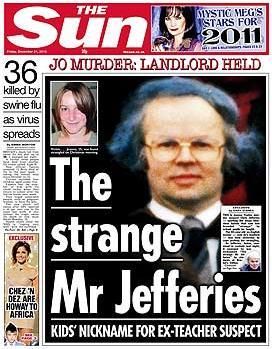 The front page of The Sun showed a small photograph of Joanna Yeates next to a cut-out from a school line-up showing Jefferies 30 years ago, with very blue hair, grinning. The headline was: “The strange Mr Jefferies – Kids’ nickname for ex-teacher suspect”. Then on page four it was dominated by four words, each accompanied by an explanatory phrase, weird: ‘Strange talk, strange walk’, posh:‘Loved culture, poetry’, lewd: ‘Made sexual remarks’, creepy: ‘Loner with blue rinse hair’. The article started by “Joanna Yeates murder suspect Chris Jefferies was last night branded a creepy oddball by ex-pupils, a teaching colleague and neighbours.” It went on to assert that he had a ferocious temper and threw things in the classroom, and that he invited pupils to his home and habitually made sexual remarks. He was also branded as being "unkempt and dirty, a loner, domineering" and generally believed to be a homosexual. The evidence for this came largely from unnamed sources.

.jpg) The UK Defamation Act 1996, exists to protect the reputation and good standing of an individual. In order to pursue a successful defamation suit the claimant must: prove that they have a reputation which can be damaged and be able to show that their reputation has been damaged. The 1996 version of the act was replaced by the 2013 version which changed a number of Defamation procedures. All defamation cases under the Senior Courts Act 1981 in the Queens Bench Division, and the County Courts Act 1984, which were “tried with a jury”, unless the trial requires prolonged examination of documents &c, are now “tried without a jury” unless the court orders otherwise. Such cases are referred through a Defamation Recognition Commission (DRC) to a new Independent Regulatory Board (IRB), to provide arbitration services. The Courts should take into account, when awarding costs and damages, whether either party in a dispute has chosen not to use the arbitration service. A successful party is required to pay all of the proceedings costs, if such a party unreasonably refused to use the arbitration service. Judgment awards of exemplary damages, where a defendant is guilty of breach of a defendant’s rights, can take into account whether either party refused to use, or join the arbitration service. Courts should take into account whether defendant first sought advice from the IRB before publication. It was changed to give a better protection to people expressing their opinions are to come into force in England and Wales.
The UK Defamation Act 1996, exists to protect the reputation and good standing of an individual. In order to pursue a successful defamation suit the claimant must: prove that they have a reputation which can be damaged and be able to show that their reputation has been damaged. The 1996 version of the act was replaced by the 2013 version which changed a number of Defamation procedures. All defamation cases under the Senior Courts Act 1981 in the Queens Bench Division, and the County Courts Act 1984, which were “tried with a jury”, unless the trial requires prolonged examination of documents &c, are now “tried without a jury” unless the court orders otherwise. Such cases are referred through a Defamation Recognition Commission (DRC) to a new Independent Regulatory Board (IRB), to provide arbitration services. The Courts should take into account, when awarding costs and damages, whether either party in a dispute has chosen not to use the arbitration service. A successful party is required to pay all of the proceedings costs, if such a party unreasonably refused to use the arbitration service. Judgment awards of exemplary damages, where a defendant is guilty of breach of a defendant’s rights, can take into account whether either party refused to use, or join the arbitration service. Courts should take into account whether defendant first sought advice from the IRB before publication. It was changed to give a better protection to people expressing their opinions are to come into force in England and Wales.